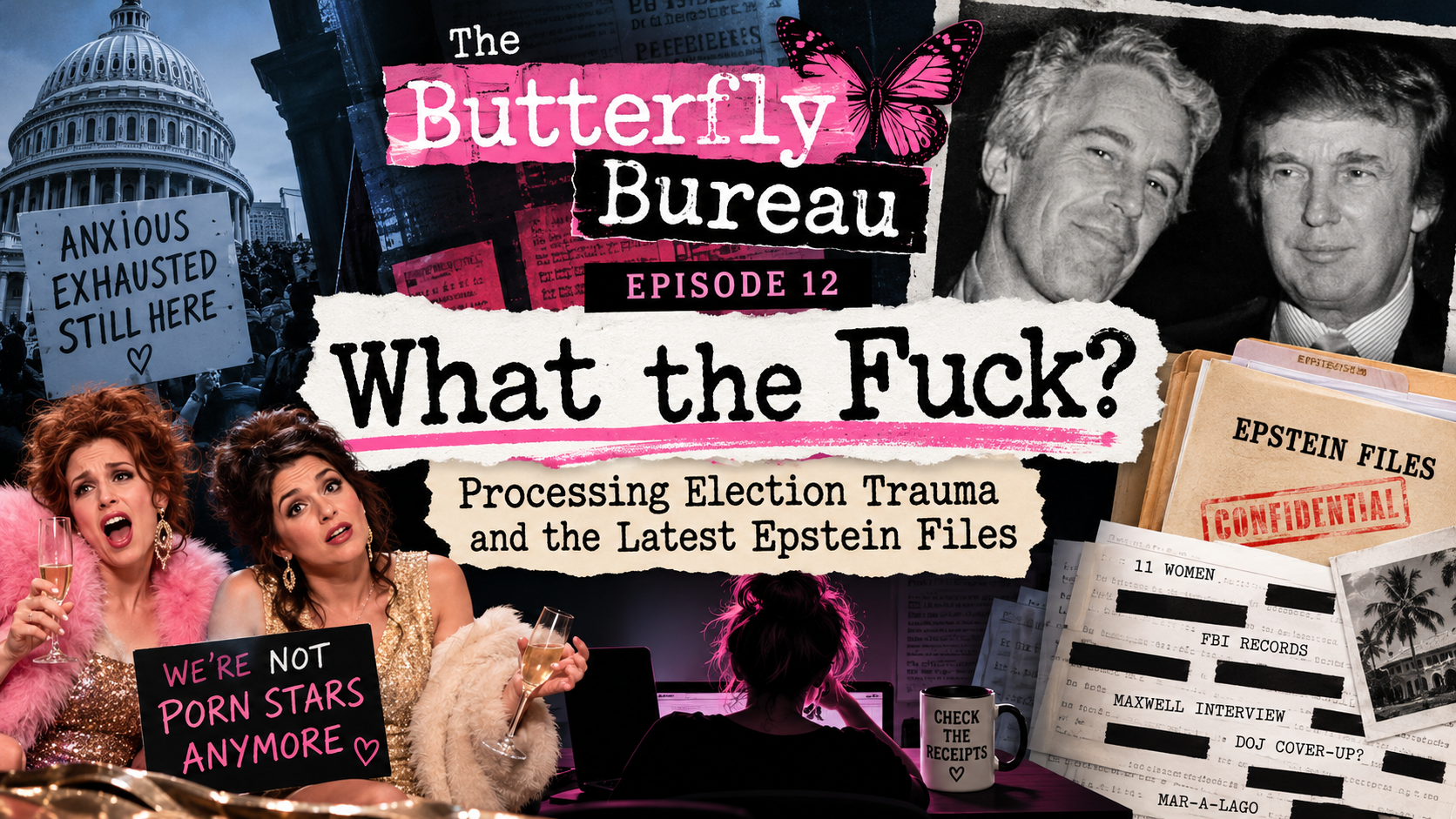
Political exhaustion, Resistance Kitty’s hilarious comparison between RSBN and Saturday Night Live, Edith’s fascinating FBI document discovery, congressional revelations, and new tools at EpsteinWiki.
Content Warning: This episode includes discussions of political trauma, sexual exploitation, child sexual abuse allegations, and failures of institutional accountability.
Episode Summary
What. The. Fuck.
Sometimes those three words are the only appropriate response to the state of American politics. Not because we have run out of intelligent things to say, but because the sheer volume of political chaos, institutional failures, and new revelations surrounding Jeffrey Epstein has become almost impossible to process.
In Episode 12 of The Butterfly Bureau, we explore the psychological toll of election season, the emotional exhaustion many Americans are experiencing, and what happens when political uncertainty becomes a permanent feature of everyday life.
We also take a detour into political comedy when Resistance Kitty explains why the two regular female commentators covering Donald Trump’s rallies for Right Side Broadcasting Network remind her of a particularly ridiculous Saturday Night Live sketch.
Then we get into the receipts.
Our sleuth Edith shares a fascinating FBI document discovery that helps researchers understand the paperwork behind federal investigations. We also discuss the explosive October 2026 House Judiciary Democrats’ report examining Donald Trump’s relationship with Jeffrey Epstein and the Justice Department’s handling of the investigative files.
Finally, we share some of the new features and research tools available on EpsteinWiki, making it easier for everyday people to explore the evidence themselves.
Because sometimes the world is so profoundly fucked up that all you can do is laugh, pull out another document, and keep investigating.
Processing Election Trauma and Political Exhaustion
As a psychotherapist and traumatologist, I have spent years helping people recognize how prolonged stress affects their nervous systems.
And American politics has become one hell of a prolonged stress experiment.
The emotional fallout from the 2024 presidential election has continued into the 2026 midterms, with many people experiencing anxiety, anger, helplessness, exhaustion, and increasing difficulty disengaging from political news.
For some people, elections represent disagreements about taxes or spending. For others, political decisions directly affect their healthcare, civil rights, relationships, bodily autonomy, or physical safety.
Those experiences carry very different psychological consequences.
The American Psychological Association’s October 2026 Stress in America report found that 74 percent of American adults identified the future of the nation as a significant source of stress.
Even more telling, 51 percent reported feeling too emotionally drained to remain engaged with everything happening in the world.
That is not simply political apathy. It reflects the very real difficulty of sustaining emotional engagement when people feel overwhelmed.
We discuss how political events can activate existing trauma, contribute to chronic hypervigilance, and erode a person’s sense of control over their future.
We also distinguish election distress from a clinical trauma diagnosis. Being furious about politics does not automatically mean someone has PTSD, although political events can aggravate previously established trauma responses.
And here is the important part.
You do not have to remain in a permanent state of psychological emergency to be politically engaged.
Resting is not surrendering. Laughing is not ignoring injustice. Taking a break from the news does not mean abandoning the people who need our support.
Our nervous systems require recovery, even when the political environment refuses to cooperate.
Resistance Kitty, RSBN, and We’re Not Porn Stars Anymore
Sometimes the only reasonable response to political absurdity is comedy.
Resistance Kitty brought up the coverage that Right Side Broadcasting Network, commonly known as RSBN, provides of Donald Trump’s political rallies.
RSBN is a conservative streaming network known for broadcasting Trump’s speeches and interviewing enthusiastic supporters at his events.
But it was the network’s two recurring female commentators who caught Kitty’s attention.
Something about their delivery, their exaggerated enthusiasm, and the almost promotional quality of their commentary reminded her of a legendary recurring sketch from Saturday Night Live.
“We’re Not Porn Stars Anymore.”
For anyone unfamiliar with these little masterpieces of comedic nonsense, Vanessa Bayer and Cecily Strong played two former adult film performers who somehow found themselves recording promotional advertisements for everything from luxury champagne to consumer products.
The characters delivered bizarre endorsements with complete confidence, mangled the English language, and cheerfully announced that they were no longer porn stars.
The comedy came from their enthusiastic sales pitches and total inability to explain what they were actually advertising.
Resistance Kitty found the resemblance to RSBN’s rally commentary absolutely hilarious.
The comparison concerns the commentators’ presentation style, not their personal lives or professions.
There is something wonderfully absurd about watching people deliver breathless promotional commentary while the rest of us are trying to determine whether we are witnessing journalism, political theater, or an elaborate infomercial.
The We’re Not Porn Stars Anymore SNL video playlist contains the sketches referenced during our conversation.
And let’s be clear. Consensual adult entertainment is not comparable to sexual trafficking or abuse. Our joke is about political broadcasting and advertising absurdity, not the exploitation of women.
Sometimes laughter is one of the ways we metabolize overwhelming experiences.
And after reading hundreds of pages about Epstein’s world, a little absurd comedy is not a terrible prescription.
Edith’s Badass Discovery: A 161 Page Collection of FBI Forms
One of the more interesting document discoveries discussed during this episode came from our sleuth Edith.
She brought a 161 page collection of FBI forms and administrative documents obtained through Freedom of Information Act requests.
The collection, Forms Used by the Federal Bureau of Investigation, 2003 to 2004, was published by GovernmentAttic in March 2022 and preserves records released by the FBI, including material dating to the early 2000s.
At first glance, a collection of government forms might not sound particularly exciting.
But understanding how federal investigative documents are created, organized, and categorized can be incredibly valuable when examining a massive archive like the Epstein files.
Investigators do not simply sit around scribbling everything in notebooks. Federal investigations generate standardized documentation designed for specific purposes.
One example is the FD 302, the FBI form used to summarize interviews and information that could become testimony.
The FBI forms collection identifies FD 302 and its continuation form, FD 302a, in its table of contents. It also includes examples of other FBI forms, such as informant contact memoranda, informant review sheets, investigative reporting forms, file covers, and administrative records.
These distinctions become important when researchers encounter material in the Epstein archive.
An FBI interview summary is not necessarily a verbatim transcript. An investigative tip is not proof that its allegations were substantiated. An administrative record may establish how a document was processed without establishing that every claim within it is accurate.
Understanding those distinctions makes it easier to evaluate what we actually have.
It also helps researchers ask more precise questions about missing paperwork, referenced interviews, followup investigations, and the difference between an investigative lead and a completed finding.
There is an important qualification to Edith’s discovery. This particular collection is a historical reference to FBI paperwork, not a newly released collection of Epstein witness interviews or evidence directly implicating a particular person.
Its value is methodological.
If you want to understand the Epstein files, it helps to understand the FBI’s own documentation system.
That is why a seemingly ordinary collection of forms can become such a useful research resource.
The FBI forms collection also provides an opportunity to compare older administrative conventions with records appearing in more recent releases.
Not exactly glamorous reading, but our sleuths are not here for the glamour.
We are here for the receipts.
The October 2026 Congressional Epstein Report
We also discussed a separate and considerably more explosive document.
On October 26, 2026, House Judiciary Committee Democrats released a 53 page staff report titled “We Have Certain Things in Common, Jeffrey”: The Case Against Donald Trump Emerging in the Epstein Files and DOJ’s Desperate Efforts to Cover It Up.
The complete congressional report examines allegations involving Trump, Jeffrey Epstein, Ghislaine Maxwell, and individuals associated with the modeling industry during the 1990s.
Its authors bring together survivor accounts, FBI records, congressional interviews, previously disclosed correspondence, and allegations concerning the Justice Department’s handling of the Epstein investigation.
One of the report’s major sections discusses eleven women whose experiences or documented relationships connect the worlds of Trump and Epstein.
Five are identified as women who directly accused Trump of sexual assault or rape. The remaining accounts concern other survivors’ experiences and women discussed through available records.
That distinction matters.
The report does not establish eleven proven victims of Trump, and its conclusions have not been adjudicated in a criminal trial.
It is a Democratic congressional staff report advancing serious allegations and recommending additional investigation.
The White House has rejected the accusations, while the Justice Department has defended its handling of the Epstein investigation and released records.
The Modeling Industry Connections
A substantial portion of the report examines the modeling industry and relationships involving Epstein, Trump, John Casablancas, and Paolo Zampolli.
The committee argues that modeling opportunities, beauty pageants, promises of career advancement, immigration assistance, and access to powerful individuals created circumstances that could facilitate exploitation.
These claims must be assessed against the underlying documents and individual accounts.
A social relationship or business connection alone does not prove involvement in trafficking.
Nevertheless, the repeated intersection of these networks is a legitimate subject of investigation.
The Maxwell Interview and Questions About DOJ
Another significant section examines Todd Blanche’s July 2025 interview with convicted sex trafficker Ghislaine Maxwell.
The committee highlights portions of the official Maxwell interview transcripts in which Blanche redirected discussion of a survivor known as Jane.
Congressional staff argue that these exchanges raise questions about whether potentially significant information was adequately pursued.
That interpretation is disputed and does not itself establish witness tampering or obstruction.
But the interview is available for readers to examine, and the questions concerning investigative completeness remain important.
What Happens Next?
The report calls for renewed investigations and an independent special counsel.
It also raises concerns about access to records and cooperation with investigations in New Mexico and the United Kingdom.
Readers can explore our EpsteinWiki analysis of the congressional report for a breakdown of the allegations, original evidence identifiers, contradictory accounts, and unresolved questions.
The larger question is not whether a politically explosive report makes for an exciting headline.
The question is whether every credible allegation has been properly investigated and whether the records needed for accountability are being preserved and disclosed according to law.
Survivors deserve answers based on evidence.
Not political convenience.
What’s New at EpsteinWiki?
We also spent a little time discussing the continuing development of EpsteinWiki and the research tools becoming available to the public.
Our goal has always been larger than publishing another collection of articles about Jeffrey Epstein.
We want people to be able to navigate the evidence, understand complicated relationships, follow the sources, and participate in responsible investigations without needing a law degree or an invitation to somebody’s secret research group.
The Evidence Board provides an interactive visual starting point for examining selected property connections and their supporting documents. Researchers can zoom, explore individual records, and follow the evidence into more detailed articles.
The Epstein Names Index makes it easier to search people appearing in the archive by name or profession and open available profiles. Inclusion in the index is not an accusation of wrongdoing.
Our Fact Checking Desk helps visitors investigate questionable claims, locate original documents, use external reverse image search tools, and distinguish real records from fabricated or misleading online content.
The Sleuth Exchange allows researchers to search published investigations and discover suggested verification tasks through its Help Crack This feature.
We have also introduced the 2026 Voter Endorsement Guide, which provides the project’s election endorsements and supporting information by state.
Additional improvements include contributor resources, survivor support information, research indexes, and easier ways to submit investigative leads.
These features are intended to make the archive more accessible, organized, and useful.
The guiding principle remains simple: follow the evidence, verify the source, and never confuse an allegation with a conviction.
A transparent research archive should help people ask better questions, not simply reinforce whatever conclusions they already believe.
Closing Sleuth Thoughts
There is a strange intersection between political trauma, comedy, and the kind of investigative work we do at The Butterfly Bureau.
All three involve trying to make sense of things that can feel completely overwhelming.
Political stress reminds us how deeply public events can affect our private lives.
Comedy gives us moments of relief when the news becomes unbearable.
And investigative research offers a way to replace confusion with information that can actually be examined.
Edith’s FBI forms discovery is an example of why careful sleuthing matters. Sometimes the most useful document is not the one making the most explosive allegation. It is the one that helps you understand how the evidence was created and what it can actually establish.
The congressional report reminds us that serious questions about the Epstein investigation remain unresolved.
And our expanding tools at EpsteinWiki give more people a chance to explore those questions themselves.
We can laugh at political absurdity without dismissing the suffering of survivors.
We can demand accountability without pretending every accusation is already proven.
And we can acknowledge that our nervous systems are exhausted without allowing that exhaustion to become permanent surrender.
So find your people. Protect your sanity. Laugh when you can.
Then open the next document.
Because sometimes the only reasonable response is:
What. The. Fuck.
And sometimes the next reasonable response is to keep digging.
Required Reading and Episode Receipts
- FBI Forms Used in 2003 and 2004 provides the historical collection shared by Edith.
- House Judiciary Democrats’ October 26, 2026 Report contains the congressional allegations and supporting source references.
- EpsteinWiki’s Congressional Report Analysis explains the report’s evidence, distinctions, and outstanding questions.
- DOJ Ghislaine Maxwell Interview Transcripts provide the original interview material discussed by congressional staff.
- American Psychological Association, Stress in America 2026 documents current national stress and political exhaustion.
- American Psychological Association, Managing Political Stress examines the psychological effects of elections and prolonged news exposure.
- Right Side Broadcasting Network provides the original network coverage referenced in Resistance Kitty’s comedy discussion.
- Saturday Night Live’s We’re Not Porn Stars Anymore Playlist contains the comedy sketches referenced during the episode.
- EpsteinWiki Research Tools provides access to the Evidence Board, Names Index, Fact Checking Desk, Sleuth Exchange, and additional research resources.