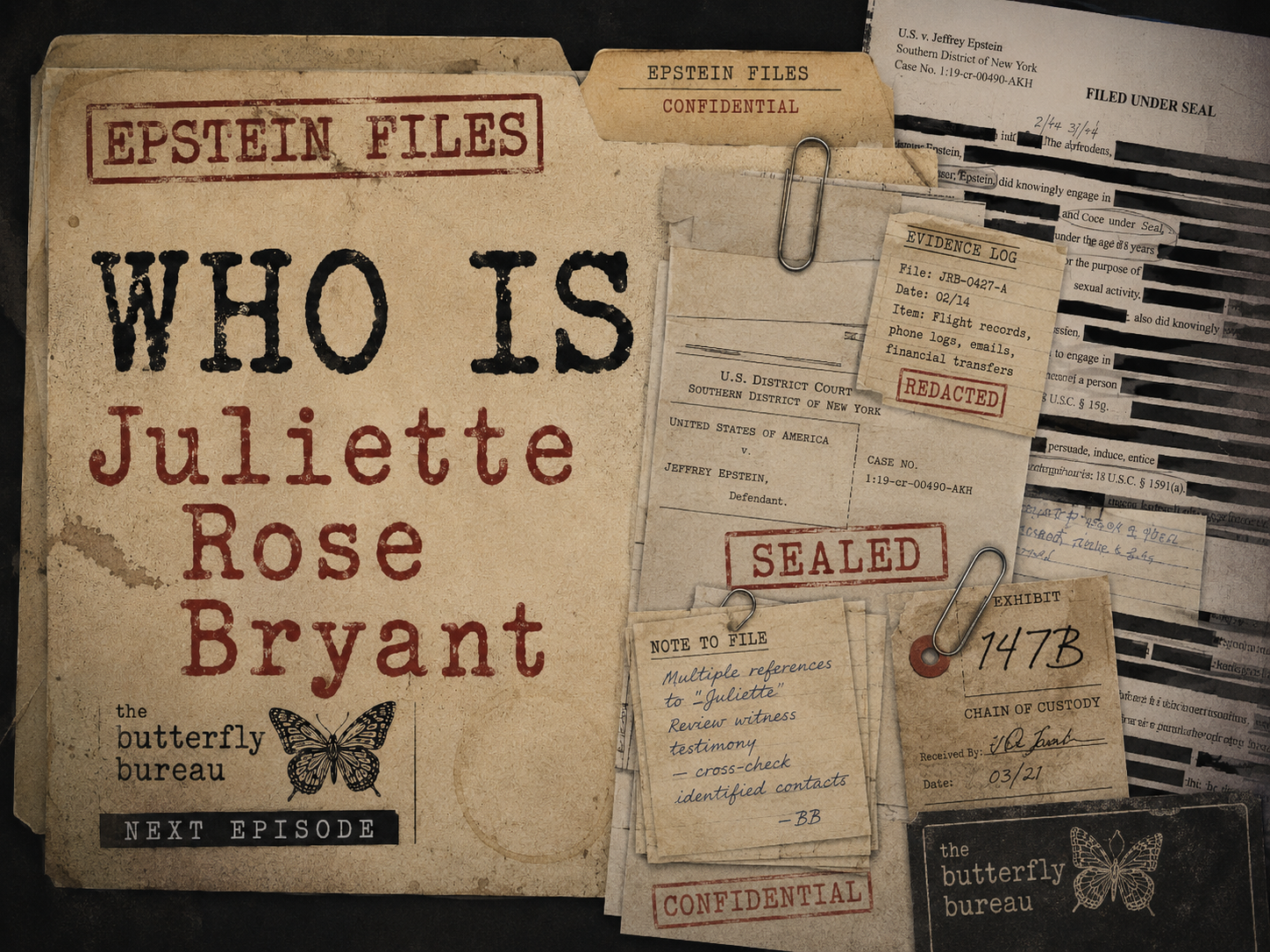
Juliette Bryant, Recruitment, Abuse, and the Evidence Trail
Episode 4: Who is Juliette Bryant by Resistance Kitty
Juliette Bryant, Recruitment, Abuse, and the Evidence Trail Watch on Substack
In Episode 4 of the Butterfly Bureau, Epstein survivor Juliette Bryant describes how a promised modeling opportunity became a system of manipulation, sexual abuse, coercion, and silence.
Bryant’s account begins in Cape Town, South Africa, in September 2002. She says she was introduced to Jeffrey Epstein while he was traveling with former President Bill Clinton, actor Kevin Spacey, and comedian Chris Tucker. Within weeks, Bryant says, Epstein’s associates arranged her passport and visa, transported her to New York, and then placed her aboard Epstein’s private aircraft.
The episode contains claims that can be compared with flight records, court filings, property records, correspondence, and other documents. It also contains personal memories and interpretations that have not been independently established by the publicly released evidence. This receipts report makes that distinction clear.
Key Takeaways
• Juliette Bryant is a publicly identified Epstein survivor who filed a federal civil action against the executors of Epstein’s estate.
• Bryant says she was recruited in Cape Town at age 20 through a purported opportunity involving Victoria’s Secret and Leslie Wexner.
• She recalls meeting Epstein while he was traveling in South Africa with Bill Clinton, Kevin Spacey, and Chris Tucker.
• Bryant says Sarah Kellen and other women participated in a staged modeling interview at the Cape Grace Hotel.
• She says Epstein’s office arranged her passport, visa, flights, transportation, and lodging.
• Bryant describes being sexually assaulted aboard Epstein’s aircraft shortly after leaving New York.
• She says she was transported to Little Saint James, Palm Beach, Paris, and Zorro Ranch in New Mexico.
• Epstein’s known properties, staff, aircraft, recruitment practices, and travel network provide important corroborating context.
• Bryant’s memories involving an unidentified laboratory, an unexplained medical procedure, egg removal, unidentified flying objects, and underground facilities remain unverified by the public record.
Bryant’s Status as a Publicly Identified Survivor
Juliette Bryant is not an anonymous internet source. She has identified herself publicly, participated in interviews, and filed a lawsuit concerning the abuse she says she experienced.
The Epstein Data survivor archive identifies Bryant as a South African survivor who filed a civil suit and reported being trafficked from Cape Town at age 20.
Readers can examine references to Bryant across the released evidence through the Juliette Bryant document search and the alternative Juliet Bryant spelling search.
Her lawsuit was filed in the Southern District of New York as Juliette Bryant v. Darren K. Indyke and Richard D. Kahn, case number 1:19 cv 10479. Indyke and Kahn were sued in their capacities as executors of Jeffrey Epstein’s estate.
A lawsuit establishes that allegations were formally presented to a court. It does not, by itself, establish that every allegation was judicially proven. However, it is an important part of the documentary record.
The September 2002 Cape Town Encounter
Bryant says she was approached at a Cape Town restaurant in September 2002 by a woman who presented Epstein as an influential associate of Leslie Wexner and Victoria’s Secret.
According to Bryant, the woman said Epstein was traveling with Bill Clinton, Kevin Spacey, and Chris Tucker. Bryant says she was taken to another Cape Town restaurant where she met the group.
The presence of Clinton, Spacey, and Tucker on an African trip with Epstein during this period has been widely documented. Their association with the trip supports the surrounding circumstances of Bryant’s account, although it does not independently prove what happened during her private interactions with Epstein or his associates.
Bryant says she retained a 2002 diary containing entries about the meeting and Clinton’s speech. During the episode, the Butterfly Bureau displayed a photograph of a diary page bearing a September 2002 date and a reference to “Clinton’s speech.”
The original diary, its complete chain of custody, and any expert examination should be published or documented before the diary is treated as independently authenticated evidence. At present, it is best described as contemporaneous material supplied by Bryant.
Researchers can examine the released records using the Bill Clinton and Cape Town search and the broader South Africa document search.
The Purported Modeling Interview
Bryant says Epstein’s associates organized a modeling interview at the Cape Grace Hotel. She identifies Sarah Kellen, Andrea Metrovich, and Cindy Lopez as women who appeared to participate.
According to Bryant, the women claimed to represent a modeling agency and reviewed her portfolio. She says Epstein then examined the portfolio and suggested that she could be suitable for Victoria’s Secret.
Bryant also recalls Clinton walking through the adjoining space during this meeting. This is her firsthand recollection. The public evidence reviewed for this report does not independently establish Clinton’s presence inside the room or prove that he knew the purpose of the meeting.
Sarah Kellen is extensively documented as a member of Epstein’s inner circle. Her established position in Epstein’s operation gives Bryant’s identification of Kellen significant investigative relevance. It does not automatically verify every detail Bryant recalls.
Relevant evidence can be explored through the Sarah Kellen document archive, the Andrea Metrovich search, and the Cindy Lopez search.
Because names are frequently misspelled in records and automated transcriptions, researchers should also search likely variations.
The First Massage and Epstein’s Screening Questions
Bryant says she was called back to the hotel after being told that Epstein’s massage therapist had failed to arrive. She recalls being offered $300 for a short massage.
According to Bryant, the encounter did not initially become overtly sexual. Instead, Epstein allegedly asked whether she had a father or boyfriend and gathered information about her family circumstances.
This pattern resembles accounts from other Epstein survivors who described massage requests being used to introduce sexual conduct, identify vulnerabilities, and test boundaries. Epstein’s recruitment system involving paid massages is well established through criminal records, survivor testimony, and civil litigation.
Bryant believes Epstein was determining whether a father, boyfriend, or other person might intervene. That explanation is an interpretation based on her experience. It is plausible within the documented recruitment pattern, but the public records cannot establish what Epstein was privately thinking.
Readers can compare this account with the massage recruitment evidence and the Palm Beach investigation records.
Passport, Visa, and Travel Arrangements
Bryant says Epstein employee Lesley Groff contacted her after the Cape Town meeting and helped arrange a passport and United States visa.
She recalls Epstein speaking directly with her mother and portraying the trip as a major educational and modeling opportunity. Bryant says her mother sought reassurance because Bryant had never traveled outside South Africa or flown internationally alone.
Lesley Groff is documented throughout the Epstein records as an employee who coordinated appointments, communications, and travel. That established role provides corroborating context for Bryant’s description.
The released materials can be examined through the Lesley Groff and Juliette Bryant search, the passport records search, and the visa records search.
Arrival at 301 East 66th Street
Bryant says she arrived in New York on October 17, 2002. She recalls a driver meeting her at the airport and transporting her to an apartment at 301 East 66th Street.
That address is associated with property connected to Mark Epstein, Jeffrey Epstein’s brother. It has appeared in reporting and records concerning housing used by people within Epstein’s network.
Bryant says she had barely settled into the apartment when Sarah Kellen telephoned and instructed her to pack a small bag for a trip to the Caribbean.
Researchers can review references to the building through the 301 East 66th Street evidence search and the alternative 301 E 66 search.
The Flight and Alleged Sexual Assault
Bryant says a driver transported her to Teterboro Airport, where she boarded Epstein’s private aircraft without understanding the true destination or purpose of the trip.
She remembers Epstein sitting at the front of the aircraft while Sarah Kellen and Andrea Metrovich sat nearby. Bryant says Epstein motioned for her to sit beside him and then sexually assaulted her shortly after the aircraft took off.
Bryant describes believing that she might be killed and that her family might never see her again. She says the other women laughed during the assault.
This is a firsthand allegation by Bryant. Flight records can potentially corroborate travel dates, aircraft movements, passengers, and destinations. They cannot independently prove conduct that occurred inside the aircraft.
Researchers should compare Bryant’s timeline with the Juliette Bryant flight record search, the Teterboro records, and the Epstein flight logs.
Little Saint James and Palm Beach
Bryant says the aircraft traveled to the Caribbean and that she was eventually taken by helicopter to Little Saint James.
She recalls being isolated with Epstein and members of his staff. Bryant says Epstein began sexually abusing her immediately and repeatedly summoned her to his bedroom.
She describes additional young women arriving and departing during the trip. She says she was later transported to Epstein’s Palm Beach residence.
Epstein’s ownership of Little Saint James, his Palm Beach residence, and his movement of young women between properties are independently established. Those facts corroborate the infrastructure described by Bryant, but they do not prove each individual incident.
Relevant records are available through the Little Saint James evidence search, the Palm Beach property search, and the helicopter records search.
Alleged Threats and Coercive Control
Bryant says Epstein claimed that he worked with the Central Intelligence Agency. She also says he threatened her by describing what he had supposedly done to another woman who accused him of rape.
According to Bryant, Epstein claimed he had arranged for drugs to be planted in the woman’s apartment and had caused her imprisonment. Bryant understood the statement as a threat against her and her family.
No publicly identified record reviewed for this report independently verifies that Epstein worked for the CIA or that he carried out the specific act Bryant describes. These statements should therefore be attributed directly to Bryant.
Their investigative significance lies in the coercive effect. Bryant says she believed Epstein possessed extraordinary political, financial, and intelligence connections. Whether or not every claim he made was true, she says those claims frightened her into silence.
Researchers can examine the released records through the Epstein and CIA search and the threat and intimidation search.
Continuing Contact and Trauma Bonding
Bryant says Epstein and Lesley Groff continued telephoning her after she returned to South Africa. She describes feeling frightened, emotionally attached, and convinced that remaining on Epstein’s good side might protect her.
Continued communication between a survivor and an abuser does not disprove abuse. Trauma bonding, coercive control, fear, financial vulnerability, and intermittent attention can keep victims connected to perpetrators.
Bryant says Epstein alternated praise with criticism of her weight and appearance. She recalls developing severe bulimia after he repeatedly suggested she was not good enough to model.
She also says Epstein offered her $4,000 per month to remain with him and $2,000 for every woman she recruited. Bryant says she refused to participate in recruitment.
The public records should be examined for communications, payments, and travel that might corroborate these statements. Relevant research points include the Juliette Bryant correspondence search, the recruitment payment search, and the Lesley Groff communication records.
Later Trips to Paris and New Mexico
Bryant says Epstein brought her back to the United States in December 2002 and again in February. She also describes traveling to Paris and later visiting Zorro Ranch in New Mexico.
She recalls Teala Davies and Nadia Marcinkova being present during portions of these travels. Davies has publicly identified herself as an Epstein survivor. Marcinkova has been repeatedly identified in litigation and reporting as a young woman brought into Epstein’s network.
Researchers can compare these recollections with the Teala Davies evidence search, the Nadia Marcinkova evidence search, the Paris travel records, and the Zorro Ranch archive.
Michael Bay and Other People Allegedly Seen at Zorro Ranch
Bryant says she met filmmaker Michael Bay at Zorro Ranch and watched Bay’s film The Rock with Epstein and other women. She also recalls encountering an unidentified scientist.
This claim should be treated cautiously. Bryant’s recollection establishes what she says she experienced, but the public evidence reviewed for this report does not independently confirm that Bay stayed at the ranch or knew about criminal conduct.
A social encounter with Epstein is not evidence of participation in Epstein’s crimes. Any reference to Bay must retain that distinction unless additional documentation emerges.
Readers can examine the released corpus through the Michael Bay and Epstein search and the Zorro Ranch guest search.
The Unresolved Zorro Ranch Claims
The most difficult portion of the interview concerns Bryant’s memories from Zorro Ranch.
Bryant says she remembers awakening naked and unable to move on a table while six people wearing protective suits stood around her. She recalls a woman approaching her neck and telling her that everything was fine before Bryant lost consciousness again.
Bryant believes an unexplained scar above her pubic area resulted from a procedure and believes her eggs were removed. She also describes seeing unusual lights in the sky and speculates about underground areas at the ranch.
These claims are not independently established by the released public evidence. No medical record, laboratory record, pathology report, witness statement, or authenticated facility record presented in this episode proves that Bryant’s eggs were removed.
The responsible conclusion is that Bryant reports a frightening memory involving possible incapacitation and an unidentified medical procedure. What happened, who was present, and whether a procedure occurred remain unresolved questions.
The claims warrant careful investigation, especially because Epstein publicly expressed an interest in genetics, reproduction, and using Zorro Ranch for a plan involving multiple women. However, Epstein’s documented interest in those subjects does not independently prove that Bryant was subjected to egg retrieval or experimentation.
Relevant records can be explored through the Zorro Ranch medical search, the New Mexico scientist search, and the reproductive genetics search.
Selena Dubin and the Need for Caution
Bryant says Epstein displayed photographs of Eva Andersson Dubin’s daughter at multiple properties. She recalls meeting the child and believes Epstein may have been her biological father.
The public record establishes a long association between Epstein and the Dubin family. It does not establish Bryant’s biological paternity theory.
Claims involving a person who was a child must be handled with particular care. Photographs, affection, or proximity cannot establish biological parentage. Only reliable genetic or documentary evidence could resolve that question.
Researchers can review the Eva Andersson Dubin evidence search and the Dubin family records.
What the Documentary Record Supports
The available record supports several important components surrounding Bryant’s account.
Epstein traveled internationally with powerful public figures. He used private aircraft and multiple residences. His staff arranged travel, appointments, lodging, and communications. Sarah Kellen and Lesley Groff held documented roles within his organization. Epstein used massage appointments as part of a broader recruitment system. He transported young women between New York, Palm Beach, the Caribbean, Paris, and New Mexico. He also maintained personal and professional relationships with scientists and academics.
These facts make the infrastructure Bryant describes consistent with Epstein’s documented operation.
The records do not currently prove every conversation, assault, threat, medical event, or interpretation described during the episode. Those portions must remain clearly attributed to Bryant unless additional evidence is located.
Why Bryant’s Testimony Matters
Bryant’s testimony demonstrates how prestige could be weaponized.
The promise did not begin with an obvious threat. It began with a modeling opportunity, a luxury hotel, famous companions, paid travel, and assurances to a worried mother. Each element increased the appearance of legitimacy.
By the time Bryant says the abuse became unmistakable, she was thousands of miles from home, without independent money, unfamiliar with the country, and dependent on Epstein’s employees for transportation and shelter.
That context is central to understanding coercion. A person does not need to be physically chained to be deprived of a meaningful ability to leave.
Fact Check Conclusion
Bryant’s identity as an Epstein survivor, her civil litigation, Epstein’s properties, the roles of several named staff members, the private aircraft network, and the broader massage based recruitment system are supported by public records.
Her descriptions of specific assaults remain firsthand allegations unless separately corroborated by witnesses or records.
Her claims involving the CIA, an unidentified laboratory, egg removal, underground facilities, unidentified flying objects, biological paternity, and human experimentation have not been independently proven by the public evidence reviewed for this report.
Acknowledging that distinction DOES NOT require dismissing Bryant. It means preserving the integrity of her testimony by accurately identifying what she remembers, what documents corroborate, and what investigators still need to determine. We are currently working on this project and will post updates as we are able.
Sources
- Butterfly Bureau Episode 4 transcript
- Hear From the Survivors at Epstein Data
- Juliette Bryant records at Epstein Data
- Jeffrey Epstein flight records
- Sarah Kellen records
- Lesley Groff records
- Little Saint James records
- Zorro Ranch records
- 301 East 66th Street records
- EFTA document containing Juliette Bryant correspondence