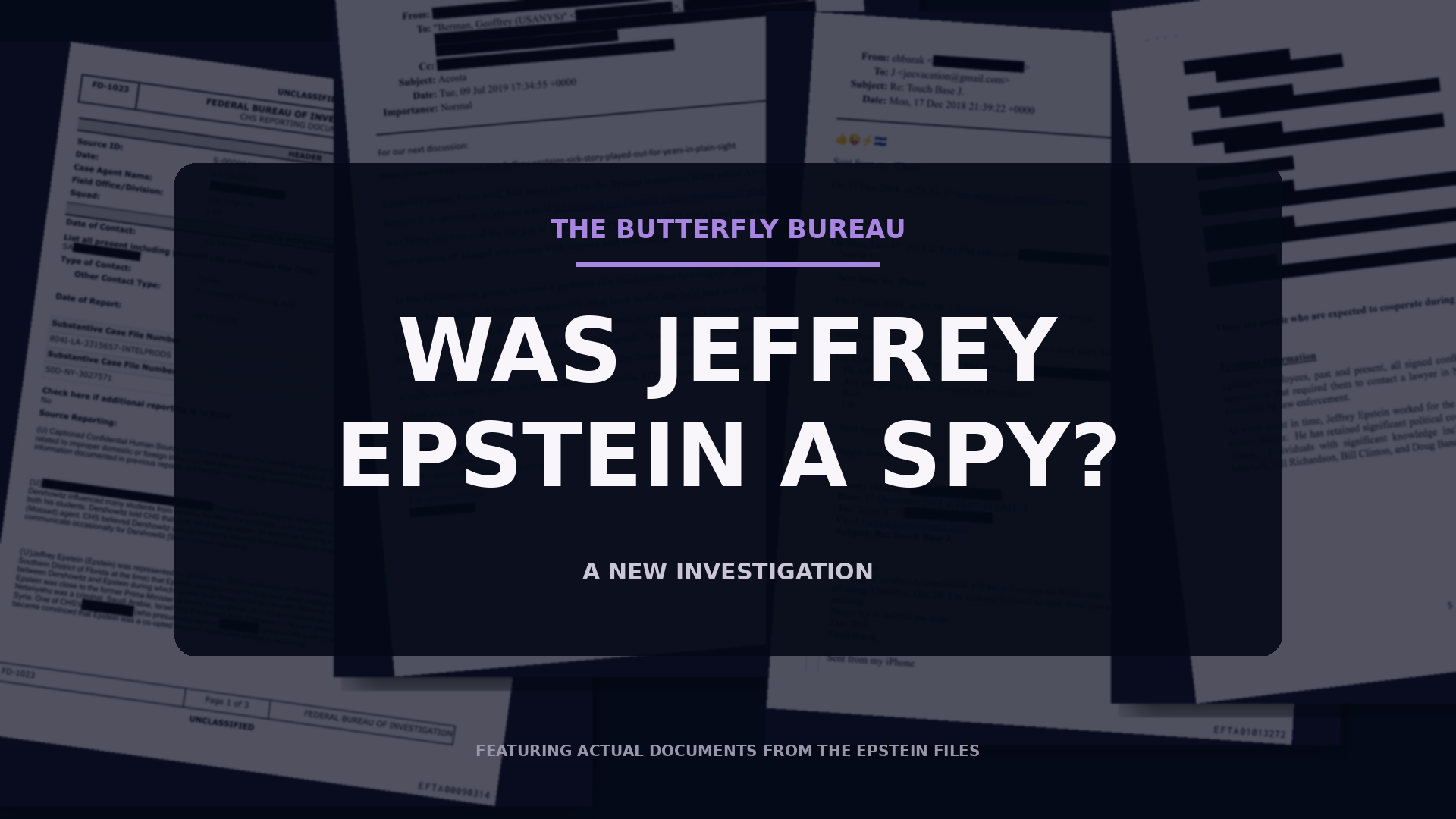
Episode 5 examines Epstein’s CIA access, diplomatic backchannels, foreign leaders, and intelligence connected relationships in the early years. Jeffrey Epstein was a convicted sex offender who somehow moved through spaces normally reserved for diplomats, intelligence officials, cabinet ministers, presidents, billionaires, and national security insiders. He attended high level Middle East meetings. He communicated directly with senior Israeli and Gulf figures. He was invited to CIA headquarters for briefings on information warfare, proliferation, and economic intelligence. He claimed personal contact with dictators. He offered powerful people private access to foreign officials and described security clearances as though arranging them were an ordinary item on his calendar.
Was Jeffrey Epstein a spy?
The documents reviewed in Episode 5 of the Butterfly Bureau do not provide a final answer. There is no public employment record, signed intelligence agreement, tasking order, payment ledger, handler communication, or authenticated agency file identifying Epstein as a formal officer or registered asset of the CIA, Mossad, or another intelligence service.
What the records do establish is that Epstein operated inside intelligence adjacent environments. He possessed unusual access to people, meetings, and information. He repeatedly positioned himself as an intermediary among political leaders, financiers, foreign governments, and national security figures.
That may describe an intelligence asset. It may describe an access agent, source, facilitator, backchannel, financial fixer, or privately useful intermediary. It could also describe an extraordinarily aggressive social climber who collected powerful relationships as protection and currency.
The receipts narrow the possibilities, but they do not yet close the case.
Key Takeaways
The 1989 congressional study trip record MS0108 bx128 fd2 lists Jeffrey Epstein alongside Representative Wayne Owens on a trip through Egypt, Saudi Arabia, Jordan, Israel, and the West Bank. The delegation met senior diplomats, political leaders, business figures, former Saudi intelligence chief Kamal Adham, and former Israeli intelligence operative Rafi Eitan.
A 1995 Council on Foreign Relations letter invited Epstein to CIA headquarters for discussions with Director of Central Intelligence John Deutch. The proposed subjects included information warfare, global humanitarian emergencies, proliferation, and economic intelligence.
A 2010 email offered Jes Staley private time with multiple foreign officials and stated that his security clearance had been approved.
A separate 2010 agenda documents the Sir Bani Yas Forum in Abu Dhabi, where foreign ministers, intelligence related officials, diplomats, and international policy figures discussed geopolitical security, Iran, nuclear proliferation, energy, and the Middle East peace process.
Epstein’s communications with Ehud Barak’s office show that arranging time with the Israeli defense minister was treated as a priority.
A February 2011 email states that Barak was scheduled to spend several hours at Epstein’s home immediately after meetings with top United States national security officials.
A 2018 email exchange records Robert Trivers describing Epstein as someone who sat with Fidel Castro and received a visit from Mahmoud Ahmadinejad. Epstein replied that he had no permanent team affiliations.
The records establish access and intermediary behavior. They do not establish formal intelligence employment.
The Earlier Timeline Changes the Question
The intelligence question does not begin with Epstein’s money, mansions, or relationship with Leslie Wexner. The additional records push the timeline back to his student years, his unusual academic claims, his early international business structure, and his repeated travel through politically sensitive regions.
None of these early records proves recruitment. Together, they show that the unexplained portions of Epstein’s biography began long before he became publicly known as a financial adviser to billionaires.
What Would It Mean if Epstein Was a Spy?
The word spy can conceal more than it explains. Intelligence agencies use different kinds of people for different purposes.
An intelligence officer is formally employed by a government agency. An asset or source provides information, access, introductions, or other assistance but may never hold an official job title. A cutout carries information between parties who do not want direct contact. An access agent creates relationships with valuable targets. A facilitator supplies travel, money, property, technology, social introductions, or private meeting space. An informal backchannel allows governments or powerful individuals to communicate outside normal diplomatic procedures.
Epstein could have performed one or more of these functions without appearing on an agency payroll. Conversely, behaving like an intermediary does not prove that an intelligence service recruited, directed, or protected him.
The correct question is not simply whether Epstein was a spy. The better questions are what services he performed, who benefited, what information passed through him, and whether any government institution knowingly protected his operation.
Receipt One: Cooper Union and CIA Recruitment in 1970
The 1970 edition of the Cooper Union student publication Cable contains a reference to a student identified as Jeff. The same publication also contains a CIA recruitment notice directed toward students.
The student reference appears in the 1970 Cable archive, while the CIA recruitment material appears elsewhere in the same publication.
This is historically interesting, but it must not be overstated. A CIA recruitment notice in a student publication does not prove that Epstein applied, was interviewed, was recruited, or had any contact with the agency.
To establish recruitment, investigators would need an application, campus recruiter report, personnel record, background investigation, training record, source file, or corroborating witness.
The Cooper Union pages prove only that Epstein attended an institution where the CIA was openly seeking recruits during that period. They identify an opportunity, not an operation.
Receipt Two: The Courant Institute and Berkeley Claims
EFTA01700759 contains material describing Epstein’s early academic history. Page 45 refers to the Courant Institute of Mathematical Sciences at New York University during the early 1970s.
Other pages refer to work at the University of California, Berkeley, an alleged National Science Foundation grant, and an association with a professor identified as Wolf. The relevant material appears around pages 17, 19, 23, and 24.
These records are evidence that the claims appeared in documents associated with Epstein. They are not automatically proof that every academic credential, grant, or appointment was genuine.
The early biography requires independent confirmation from university enrollment records, employment records, grant databases, faculty files, payroll documents, and National Science Foundation archives. If the claims were inflated or false, investigators should ask who accepted them and how they helped Epstein enter teaching, finance, and international power networks without a completed degree.
If they were accurate, the records would place Epstein in advanced mathematics environments before his move to the Dalton School and Bear Stearns. Either result matters because his technical identity became an important part of the persona he later used with scientists, financiers, and government figures.
Receipt Three: Intercontinental Assets Group
New York corporate records show that Intercontinental Assets Group, Inc. was registered on August 18, 1981.
The corporate entry identifies the company and registration date.
The company’s name is notable because Epstein later described himself as an international financial consultant and traveled extensively across Europe, Africa, Israel, and the Middle East. A corporate registration alone does not reveal its clients, revenue, owners, employees, contracts, or international activities.
Investigators need the complete incorporation file, tax returns, bank records, client agreements, beneficial ownership information, correspondence, and foreign transactions. The intelligence value of a financial intermediary depends on what money and information moved through the business, not the name printed on its registration.
Receipt Four: The Austrian Passport Under an Alias
EFTA00021627 contains images of an Austrian passport bearing Epstein’s photograph but issued under the name Marius Robert Fortelni. The document listed a Saudi Arabian residence and was issued during the early 1980s.
Federal agents found the passport in a locked safe in Epstein’s Manhattan residence in 2019 alongside cash and loose diamonds.
Epstein’s attorneys argued that the passport had been given to him by a friend and had been kept for protection during Middle East travel. They claimed it was not used for travel. Prosecutors treated the passport as evidence relevant to his ability to flee.
Former United States Attorney Geoffrey Berman later wrote about the discovery of Epstein’s passports. Questions have also been raised about whether another foreign passport may have existed, including a reported Israeli passport. That additional claim should not be treated as established without the underlying inventory, passport image, issuing record, or sworn testimony.
The Austrian passport is genuine evidence of an alternate identity document. Its existence is highly unusual. However, false or alias travel documents may be used by intelligence personnel, criminals, fugitives, protected travelers, or people attempting to conceal politically sensitive travel. The document alone does not identify who obtained it, why it was issued, whether it was authentic when created, or whether any intelligence service authorized it.
Receipt Five: Repeatedly Lost Passports and Politically Sensitive Travel
State Department records obtained by ABC News show that Epstein repeatedly reported United States passports lost or stolen during the 1980s.
In 1983, he requested a replacement before traveling to London. In 1985, he reported living in London and sought another replacement before a flight to Sweden. Another passport was reportedly stolen from his jacket while he was dining.
The records also show requests for second passports to avoid conflicting visa stamps while traveling between Israel and Arab states, including Jordan and Saudi Arabia. Later itineraries included Afghanistan, Kazakhstan, Senegal, Sierra Leone, Mali, Gabon, and other destinations.
United States policy can permit legitimate travelers to hold a limited second passport when visa requirements conflict. That fact prevents the second passport requests from serving as proof of covert activity.
The broader pattern remains significant. Epstein traveled frequently, reported several passports missing, maintained extensive access in London, Israel, Saudi Arabia, and the Gulf, and possessed an Austrian passport under another name.
Investigators should compare every passport application with border records, visa applications, aircraft logs, hotel records, financial transactions, and meetings documented in his calendars.
Receipt Six: Douglas Leese and the Pentagon Story
Journalist Vicky Ward reported that British defense figure Douglas Leese played an important role in Epstein’s early international network. Her reporting described Epstein moving around arms, defense, and intelligence connected circles and included an account involving a Pentagon meeting.
Leese was connected to international defense business and to Adnan Khashoggi, whose arms dealing and relationships intersected with intelligence services and the Iran Contra affair.
The Pentagon account remains reporting rather than a released government attendance record. Investigators should obtain visitor logs, appointment calendars, travel records, correspondence, and the names of officials present before treating the meeting as conclusively established.
Even as an unresolved lead, the Leese connection helps explain how Epstein may have entered international defense and intelligence adjacent networks before his relationship with Wexner became the central public explanation for his power.
Receipt Seven: The Pottinger Office and the Drysdale Network
Reporting has placed Epstein in shared office space connected to the Pottinger orbit during his early business years. The significance of an office share depends on who used the space, what business was conducted there, and whether the arrangement produced introductions to defense, political, or foreign clients.
EFTA01179172 contains material related to the Drysdale matter and names including Ana Obregón, attorney Andrew Levander, and Robert Gold.
House Oversight document HOUSE_OVERSIGHT_021961 provides additional evidence associated with this network.
The Drysdale material shows Epstein functioning in disputes and recovery work involving wealthy international clients. It is relevant to his development as a fixer who claimed he could recover hidden or disputed assets.
Asset recovery work can require corporate research, foreign banking knowledge, investigators, lawyers, government contacts, and access across jurisdictions. Those skills are useful in legitimate finance, private intelligence, litigation, covert finance, and criminal activity alike.
The records do not prove intelligence tasking. They show the kind of work through which Epstein could acquire sensitive financial information and relationships with people capable of using it.
Receipt Eight: The Zaire Claim and Presidential Guards
Epstein’s birthday book contains a reference placing him in Zaire during the middle of the 1980s with presidential guards. The relevant material appears around page 7 of the released book.
The House Oversight release contains the birthday book material.
A later Bannon exchange records Epstein claiming that he had been with Mobutu Sese Seko, the dictator of Zaire, during the same general period.
The two items reinforce each other, but neither is a neutral government travel record. One is a commemorative social document and the other records Epstein’s own claim.
Mobutu was a major Cold War ally of the United States whose government maintained deep relationships with Western intelligence services. Verified access to Mobutu’s presidential circle would therefore be highly relevant.
Investigators should obtain Epstein’s passports, Zairian entry records, photographs, hotel records, flight documents, diplomatic communications, and testimony from guards or other travelers.
Receipt Nine: The 1980 Israel Trip Reference
The birthday book also contains a letter from Seymour referring to an Israel trip during late November or early December 1980. The relevant material appears around page 31.
The letter is contained in the released birthday book.
This reference places Israel inside Epstein’s travel history earlier than many commonly cited accounts. It does not disclose the purpose of the trip, the people he met, or whether the travel was personal, financial, political, or connected to another activity.
The trip should be compared with passport stamps, airline records, Israeli entry records, Leese related communications, and Epstein’s business activity during the same period.
Receipt Ten: The 1989 Congressional Middle East Study Trip
One of the earliest and most important documents is a 237 page record titled “CODEL Owens Study Trip on the Peace Process and Regional Economic Cooperation.” The trip took place from March 24 through April 4, 1989.
The cover lists four participants: Representative Wayne Owens, Jeffrey Epstein, Dan Gordon, and David Mitchell.
The delegation traveled through Egypt, Saudi Arabia, Jordan, Israel, and the West Bank. Its meetings included United States ambassadors, foreign ministers, banking officials, royal advisers, senior Israeli political figures, Palestinian representatives, and regional business leaders.
The participant list included Benjamin Netanyahu, then serving as Israel’s deputy foreign minister, Shimon Peres, Moshe Arens, King Hussein of Jordan, Saudi Crown Prince Abdullah, Kamal Adham, and Rafi Eitan.
Adham was not merely a Saudi businessman. He had served as the head of Saudi Arabia’s intelligence service and was an important liaison with the CIA during the Cold War. The trip notes record a March 28, 1989 meeting with him in Jeddah.
Rafi Eitan was a former Israeli intelligence operative associated with Mossad and Lekem. He later acknowledged his role in the operation involving Jonathan Pollard. During the period covered by the trip document, Eitan served as chairman of Israel Chemicals.
The trip record’s reference to Rafi Eitan is especially important because the title “chairman of Israel Chemicals” can make the meeting look purely commercial. His intelligence history gives the encounter a different context. It still does not prove that Epstein met him for an intelligence purpose.
The notes discuss Israeli and Arab security concerns, financial vehicles, regional cooperation, technology transfers, political intermediaries, and methods for conducting sensitive cooperation without making Israel’s involvement visible.
The document does not identify Epstein’s official role. That absence is itself notable. He was not a member of Congress, government employee, diplomat, or publicly known Middle East specialist. Yet he traveled with a congressional delegation into meetings with some of the region’s most powerful political and intelligence connected figures.
This does not prove he was working for an intelligence service. It proves that his access to geopolitical power began much earlier than the public story of a wealthy New York financier would suggest.
Receipt Eleven: Epstein Was Invited to CIA Headquarters
On October 2, 1995, Council on Foreign Relations president Leslie Gelb sent Epstein an invitation to visit CIA headquarters with Maurice “Hank” Greenberg and a select group of Council members.
The letter stated that Director of Central Intelligence John Deutch would host the group and join them for lunch. It described a broad discussion involving the intelligence community, reform efforts, unconventional weapons proliferation, terrorism, and economic intelligence.
Handwritten planning notes associated with the visit list briefings on information warfare, global humanitarian emergencies, proliferation, and economic intelligence.
The invitation is significant for several reasons. Epstein had joined the Council on Foreign Relations during the same period in which he was rapidly gaining entry into elite political, financial, and international policy circles. The invitation also placed him inside a small group being given direct access to the sitting CIA director and agency briefers.
However, the surviving invitation proves that Epstein was invited. It does not, by itself, prove that he attended. A confirmed visitor log, attendance sheet, security entry record, contemporaneous diary, or agency memorandum would strengthen that conclusion.
The document nevertheless destroys the claim that Epstein’s intelligence connections are based solely on internet speculation. His access to CIA leadership was at least contemplated and formally arranged through the Council on Foreign Relations.
Receipt Twelve: Information Warfare and Economic Intelligence
The handwritten CIA visit agenda is unusually relevant to Epstein’s later activities. It lists information warfare, global humanitarian emergencies, proliferation, and economic intelligence.
These were not casual policy topics. Information warfare concerns the use, protection, manipulation, and strategic exploitation of information. Economic intelligence can include the collection and analysis of financial, commercial, technological, and sanctions related information. Proliferation work examines the movement of weapons, materials, technology, financing, and expertise across borders.
Epstein later operated among billionaires, banks, scientists, political campaigns, weapons connected officials, foreign leaders, and technology entrepreneurs. He also maintained a trafficking operation capable of generating intensely compromising information about powerful people.
That later pattern makes the 1995 agenda relevant. It does not establish that the CIA trained or tasked him. It shows that he was invited into an environment where the strategic value of information, finance, technology, and private access was being explicitly discussed.
Receipt Thirteen: The Sir Bani Yas Forum
EFTA00726612 is the agenda for the inaugural Sir Bani Yas Forum held near Abu Dhabi from November 5 through November 8, 2010. The gathering was organized by the United Arab Emirates and the International Peace Institute.
Its sessions addressed the Middle East peace process, Iran, geopolitical security, energy security, and nuclear proliferation. Participants included foreign ministers, former government leaders, policy experts, journalists, and officials responsible for intelligence and atomic energy matters.
The agenda names Mahmoud Abbas, Yasser Abed Rabbo, Dan Meridor, Martin Indyk, Tony Blair, Robert Malley, Bruce Riedel, and numerous foreign ministers. Meridor appeared in his capacity as Israel’s deputy prime minister and minister responsible for intelligence services and the Atomic Energy Commission.
EFTA00777934 contains a message sent through Epstein’s email account listing the foreign ministers and senior officials expected at the event. It states that Epstein’s attendance would be greatly appreciated.
These were not merely wealthy dinner guests. They were officials discussing active conflicts, regional security, Iran, nuclear proliferation, energy access, and diplomatic strategy.
Epstein’s presence or expected presence at this kind of closed international gathering is consistent with the role of an elite intermediary. It does not reveal who invited him for what purpose, what meetings he attended, or what information he carried away.
Receipt Fourteen: Private Time and an Approved Security Clearance
EFTA01811353 is a one page message dated October 1, 2010, from Epstein to JPMorgan executive Jes Staley.
The message tells Staley that he may have private time with each of several foreign officials and that his security clearance has been approved. It then lists officials from Bahrain, Egypt, Kuwait, Lebanon, Luxembourg, Morocco, Nigeria, Pakistan, Portugal, Qatar, South Korea, Spain, Switzerland, and the United Arab Emirates.
The language is extraordinary. Epstein presented himself as someone who could facilitate private contact between a senior banker and foreign ministers while communicating the status of a security clearance.
The phrase “security clearance” may have referred to event vetting rather than access to classified United States government information. The document does not define the term. It should not be described as proof that Epstein or Staley possessed a federal classified information clearance.
Even with that limitation, the message documents Epstein functioning as an access broker at an international diplomatic gathering.
Receipt Fifteen: The Abu Dhabi Foreign Ministers Meeting
EFTA00726612, EFTA00777934, and the October 2010 email chain concerning Israeli officials fit together.
One message says Epstein would attend the Abu Dhabi meeting of foreign ministers and intended to spend time with Mahmoud Abbas, Yasser Abed Rabbo, and Salam Fayyad. Another message asks that the information be passed to Ehud Barak through Barak’s wife and office contact, Nili Priel.
Epstein also wrote that he wanted to speak with former Senate majority leader George Mitchell before the gathering. Mitchell was then the United States special envoy for Middle East peace.
The available documents do not reveal the substance of the proposed conversations. They do establish that Epstein was coordinating his access with people connected to Israeli leadership and the United States peace process.
This is classic backchannel territory, although the receipts do not establish that any government formally authorized him to act as a backchannel.
Receipt Sixteen: Ehud Barak Was Epstein’s Priority
EFTA00760666 contains an April 2010 scheduling chain involving Nili Priel and people arranging Epstein’s calendar.
The message states that if Epstein had a chance to meet Barak in New York, “that is his priority.” The exchange works around Barak’s official schedule in Washington and New York and attempts to secure a private meeting.
Barak was not simply a retired politician. He had served as Israel’s prime minister, defense minister, military chief of staff, and a highly decorated commando officer. His responsibilities placed him at the center of Israeli defense and national security policy.
The document proves a determined effort to arrange private time. It does not reveal what Epstein and Barak discussed or whether Epstein was acting for another party.
Receipt Seventeen: Barak’s Visit After White House Meetings
EFTA01835740 contains a February 10, 2011 email from Epstein to Boris Nikolic.
The message reproduces information about Barak’s meetings with Secretary of State Hillary Clinton, Defense Secretary Robert Gates, National Security Adviser Tom Donilon, and congressional leaders. It then states that Barak’s next stop would be Epstein’s house at 8 in the morning for several hours.
This is one of the strongest access receipts in the collection. A serving Israeli defense minister reportedly moved from meetings with the highest levels of the United States national security establishment to a lengthy private meeting at Epstein’s home.
The email does not document what Barak told Epstein. It does not show that classified information was discussed. It does show that Epstein occupied a position from which he could receive a senior foreign defense official immediately after sensitive government meetings.
That is precisely the kind of access an intelligence service, private intelligence firm, financial institution, or foreign government might value.
Receipt Eighteen: Sultan Bin Sulayem Asked Epstein for Political Access
A September 22, 2009 message from Sultan Ahmed bin Sulayem to Epstein describes an official South American tour planned by United Arab Emirates foreign minister Abdullah bin Zayed.
The itinerary included Argentina, Cuba, Brazil, the Dominican Republic, Peru, and Venezuela. The message states that meetings with several foreign ministers and presidents had been confirmed. It then asks Epstein for assistance obtaining an appointment with the president of Venezuela.
This is evidence that a powerful Emirati businessman believed Epstein could help open a door to a head of state.
The request does not establish whether Epstein succeeded. It does show that his network was perceived as useful for international political access far beyond the United States and Israel.
Receipt Nineteen: Castro, Ahmadinejad, and No Permanent Team
EFTA02497359 contains a March 2018 exchange between Epstein and evolutionary biologist Robert Trivers.
Trivers described Epstein as politically “polymorphic,” pointing to his apparent relationships across incompatible ideological camps. He referred to Epstein sitting with Fidel Castro and receiving a visit in New York from Iranian president Mahmoud Ahmadinejad.
Epstein replied that he was polymorphic in his thinking and saw no permanent team affiliations that worked in the long run.
The message is not an independent confirmation of every meeting Trivers described. It records what a close associate believed about Epstein’s access and Epstein’s own refusal to identify with a stable political camp.
That posture is compatible with an international fixer whose value depends on moving among rival factions. It is also compatible with a financier who preferred relationships over ideology.
Receipt Twenty: Epstein Claimed Contact With Mobutu
EFTA00881743 contains a 2018 exchange between Epstein and Steve Bannon. During a conversation about cryptocurrency, political organizations, and populist financing, Epstein claimed that he had been with Mobutu Sese Seko in Zaire during the middle of the 1980s.
Mobutu was a dictator and a major Cold War ally of the United States. His government had longstanding relationships with Western intelligence services.
Epstein’s statement is evidence that he made the claim. It is not independent proof that the meeting occurred. Travel records, photographs, diplomatic cables, passports, or testimony from other participants would be necessary to verify it.
The claim is nevertheless consistent with the 1989 record showing Epstein entering sensitive political environments years before his public image as a mysterious billionaire had fully formed.
Receipt Twenty One: Bannon, Intelligence, and Strategy
The episode materials include a later message exchange involving Steve Bannon. The messages refer to intelligence being “superb,” strategy, a coup, and an upcoming SCIF discussion.
A SCIF is a sensitive compartmented information facility used for handling classified information. However, the screenshot contains redactions and does not clearly establish the identity of every participant or show that Epstein authored the relevant messages.
This image should therefore be treated as a lead, not a conclusive receipt. The original file, complete metadata, participant identities, and surrounding conversation are needed before it can support a firm claim about Epstein.
Receipt Twenty Two: The $100 Million Proposal
Another episode document contains a May 2013 message from Boris Nikolic to Epstein. It says that “Bill” was awaiting Epstein’s answer and considered $100 million per year for no more than 30 percent of Epstein’s time fair for the first three years. It also refers to possible bonuses and the purchase of an algorithm for a foundation.
The amount is extraordinary. The document suggests that someone identified as Bill believed Epstein possessed services or knowledge worth hundreds of millions of dollars.
However, the displayed document identifies the person only as “Bill.” Context may suggest a particular individual, but the page alone does not prove that identification. The proposal also does not establish that Epstein accepted, that money changed hands, or what work was expected.
This is a valuable investigative lead. It is not yet a completed financial receipt.
Receipt Twenty Three: The Paris Investigation Shows the Network Was International
A July 22, 2026 press release from the Paris prosecutor describes an ongoing organized human trafficking investigation connected to Daniel Siad and people identified through the American Epstein files.
The prosecutor stated that investigators had obtained access to approximately 1.5 million published documents, that 24 women had come forward or been identified, and that investigators were examining conduct connected to Siad and other possible participants. The release also described international investigative cooperation and special investigative techniques.
This document does not prove that Epstein was an intelligence operative. It demonstrates that the trafficking network and related allegations extended across borders and continued to require international law enforcement coordination.
An international criminal network can overlap with intelligence connected people without being an intelligence operation. The existence of one does not automatically prove the other.
The Blackmail Question
Any serious examination of the intelligence hypothesis must address blackmail.
Epstein maintained multiple residences, private aircraft, employees, recruiters, surveillance equipment, financial relationships, and access to powerful guests. Survivors have described a systematic sexual abuse and recruitment structure. Evidence collected from his properties reportedly included large quantities of photographs and digital media.
Sexual compromise has long been useful to intelligence services, criminal organizations, private investigators, and extortionists. That historical reality makes the blackmail hypothesis plausible enough to investigate.
Plausibility is not proof. To establish an intelligence controlled compromise operation, investigators would need evidence showing that sexual encounters were deliberately recorded, the resulting material was cataloged, information was provided to a government service, targets were pressured, or Epstein received protection in exchange.
The public record contains fragments of this possible system, but no released document completes the chain.
The Protection Question
The intelligence hypothesis persists partly because Epstein repeatedly received treatment that appeared unavailable to ordinary defendants.
The 2007 federal nonprosecution agreement protected Epstein and included unusually broad language concerning potential coconspirators. His state sentence allowed extensive work release. He continued to socialize with powerful people after becoming a registered sex offender.
Former United States Attorney Alex Acosta was later reported to have said that he had been told Epstein belonged to intelligence and to leave the matter alone. That account has been widely repeated, but it remains secondhand. No public memorandum, sworn testimony, recording, or agency document has authenticated the alleged instruction.
The favorable treatment is documented. The claim that intelligence status caused it remains unproven.
What the Documents Prove
The records prove that Epstein had access to high level political, diplomatic, financial, and national security circles for decades.
They prove that Epstein attended Cooper Union while the CIA openly advertised recruitment opportunities in a campus publication. They do not prove he responded to that advertisement.
They prove that documents associated with Epstein contained claims about early work at the Courant Institute, Berkeley, and an NSF supported project. The accuracy of each academic claim requires independent confirmation.
They prove that Epstein possessed an Austrian passport carrying his photograph under another name and a Saudi Arabian address.
They prove that he repeatedly requested replacement or additional United States passports and traveled frequently through Europe, Africa, Israel, and Arab states.
They prove that Epstein’s early business and social network included international asset recovery, defense connected figures, and politically sensitive travel.
They prove that he traveled with a congressional delegation through the Middle East in 1989.
They prove that the delegation met former Saudi intelligence chief Kamal Adham and former Israeli intelligence operative Rafi Eitan.
They prove that he was invited to a CIA headquarters program hosted by Director John Deutch in 1995.
They prove that he was expected at a closed Abu Dhabi forum involving foreign ministers and discussions of Iran, nuclear proliferation, intelligence, energy, and regional security.
They prove that he facilitated or attempted to facilitate private meetings among bankers, foreign officials, and political leaders.
They prove that he maintained direct access to Ehud Barak and that Barak was reportedly scheduled to visit Epstein’s home after meetings with senior United States officials.
They prove that powerful international figures believed Epstein could help secure political access.
They prove that Epstein presented himself as a person without permanent political allegiance who could move among hostile ideological camps.
What the Documents Do Not Prove
- The records do not prove that Epstein was employed by the CIA, Mossad, MI6, Saudi intelligence, or any other service.
- They do not identify an intelligence handler.
- They do not contain a tasking order, operational payment, agent file, source evaluation, or formal recruitment record.
- They do not prove that Epstein responded to the 1970 CIA recruitment advertisement at Cooper Union.
- They do not prove that every academic credential appearing in records associated with Epstein was authentic.
- They do not prove that the Austrian passport was issued or used by an intelligence service.
- They do not prove that repeated passport replacements were part of clandestine travel.
- They do not prove that his encounters with Kamal Adham or Rafi Eitan involved intelligence business.
- They do not prove that Epstein attended the 1995 CIA visit merely because he was invited.
- They do not prove that the “security clearance” mentioned in the 2010 email was a United States classified information clearance.
- They do not prove that classified information was discussed at Epstein’s home.
- They do not prove that Epstein’s trafficking operation was created or directed by an intelligence service.
- They do not prove that every story Epstein told about meeting dictators was true.
The Most Defensible Conclusion
The public evidence does not support declaring as fact that Jeffrey Epstein was a formal spy. It strongly supports describing him as intelligence connected and as an international access broker operating in environments valuable to intelligence services.
He moved money, people, introductions, information, and influence across borders. He cultivated leaders from rival political systems. He provided private spaces for meetings. He maintained relationships with people responsible for defense, intelligence, finance, science, diplomacy, and technology.
Whether he did this on behalf of a government, several governments, private clients, himself, or some shifting combination remains unanswered.
The most revealing line may be Epstein’s own statement that he had no permanent team affiliations. That is not a confession of intelligence work. It is a description of a man whose value depended on never belonging entirely to one side.
Documents Investigators Still Need
A real answer will require records that have not been publicly produced.
Investigators should obtain CIA visitor logs and briefing records for the October 1995 Council on Foreign Relations visit.
They should obtain any CIA, FBI, State Department, Defense Department, National Security Agency, and foreign intelligence files mentioning Epstein.
They should examine the complete financial records behind his work for wealthy clients and identify unexplained foreign payments.
They should compare his passports, aircraft records, calendars, and communications with known diplomatic and intelligence events.
They should identify the purpose of his 1989 congressional trip and determine who authorized his participation.
They should obtain Cooper Union, Courant Institute, Berkeley, and National Science Foundation records capable of confirming or disproving Epstein’s early academic claims.
They should obtain the issuing file for the Austrian passport and determine who supplied the identity, photograph, Saudi address, and supporting documents.
They should reconstruct Intercontinental Assets Group’s clients, bank accounts, contracts, foreign transactions, and beneficial ownership.
They should obtain Pentagon visitor records and files concerning Douglas Leese, Adnan Khashoggi, Kamal Adham, Rafi Eitan, and any meetings involving Epstein.
They should obtain the complete records of his meetings with Ehud Barak, Sultan bin Sulayem, foreign ministers, and other international officials.
They should identify whether compromising material was collected, cataloged, shared, sold, or used for leverage.
Until those records are released, the spy question remains open by design.
In Closing
Jeffrey Epstein did not merely collect famous friends. He built a network that crossed governments, banks, royal families, universities, political movements, and national security institutions.
The receipts do not give us permission to replace investigation with certainty. They give us something more useful: a documented map of where the next questions must be asked.
Was Jeffrey Epstein a spy? The honest answer is that the released documents do not prove it. They prove that he operated close enough to intelligence power, diplomatic backchannels, and sensitive information that every relevant government should be required to open its files.
Listen to Episode 5 of the Butterfly Bureau for the complete discussion of Jeffrey Epstein’s intelligence connections, international access, and the documents that keep the spy question alive.
Sources
- 1970 Cooper Union Cable student reference
- 1970 Cooper Union Cable CIA recruitment notice
- EFTA01700759, early academic history materials
- Intercontinental Assets Group corporate record
- EFTA00021627, Austrian passport under the Fortelni name
- ABC News report on Epstein’s passport history and international travel
- Geoffrey Berman, Holding the Line
- Vicky Ward, Was Jeffrey Epstein a Spy?
- EFTA01179172, Drysdale related material
- HOUSE_OVERSIGHT_021961
- House Oversight birthday book release
- EFTA00881551, Bannon correspondence
- United States Department of Justice Epstein Library
- EFTA00726612, Sir Bani Yas Forum agenda
- EFTA00760666, scheduling communications involving Ehud Barak
- EFTA00777934, list of foreign ministers and senior officials
- EFTA00881743, Epstein and Steve Bannon exchange
- EFTA01811353, private time and approved security clearance email
- EFTA01835740, Ehud Barak visit to Epstein’s home
- EFTA02497359, Robert Trivers exchange concerning Castro and Ahmadinejad
- International Peace Institute report on the 2010 Sir Bani Yas Forum
- Nina Burleigh report on Epstein’s 1995 CIA invitation
- Paris Prosecutor