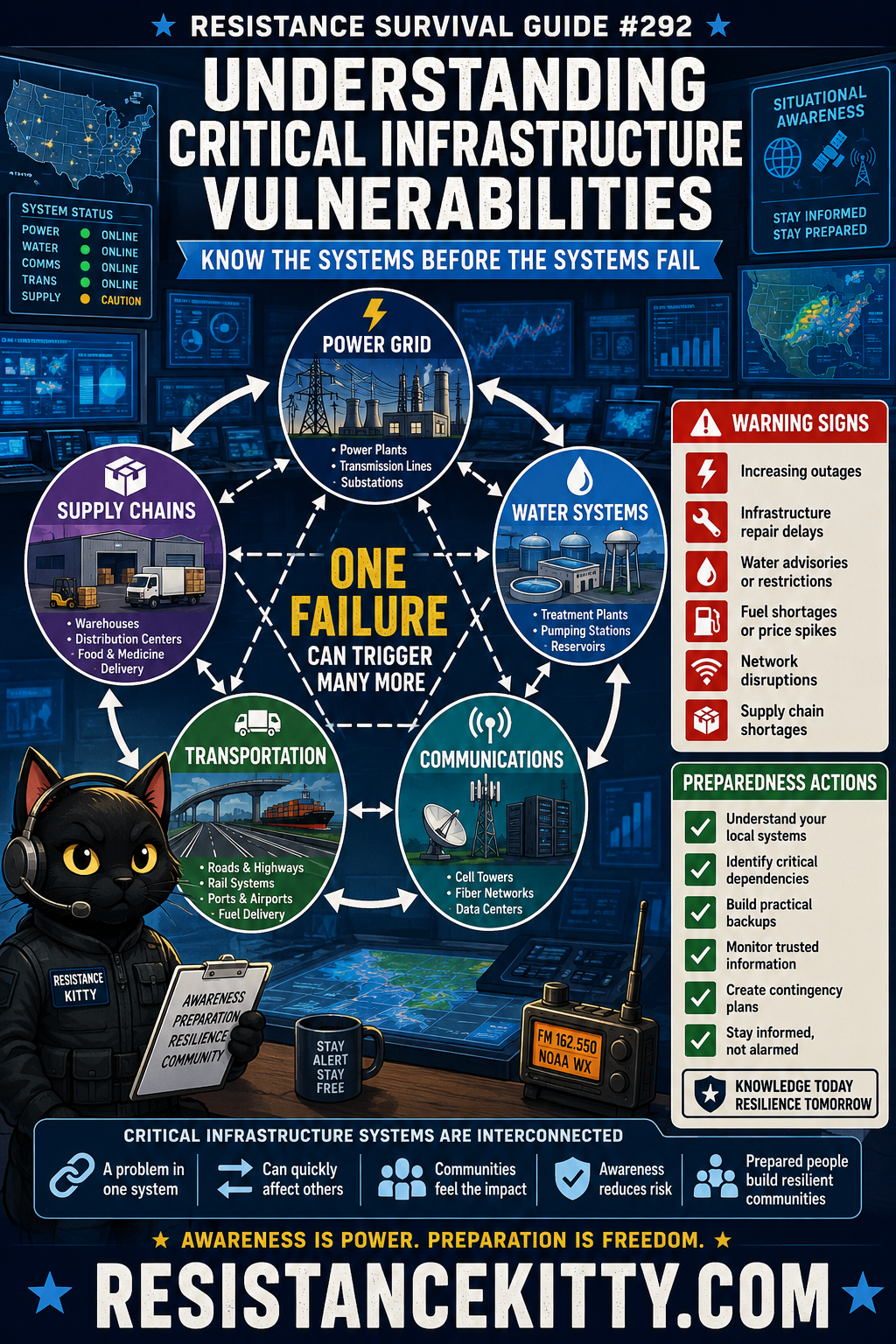
Resistance Survival Guide #292
How Critical Infrastructure Works And Why Understanding It Matters
Most people only notice critical infrastructure when it fails. The lights go out. The water stops flowing. Cell phones lose service. Gas stations run dry. Grocery shelves empty. Roads close. Yet these systems operate around us every day, quietly supporting modern life.
Critical infrastructure refers to the essential systems that allow society to function. Power grids deliver electricity. Water treatment facilities provide clean drinking water. Telecommunications networks carry internet and phone traffic. Transportation systems move people and goods. Supply chains ensure food, medicine, fuel, and other necessities reach communities.
Understanding how these systems work is one of the most valuable preparedness skills a person can develop. You do not need to be an engineer to recognize warning signs, identify vulnerabilities, or prepare for disruptions. The goal is not fear. The goal is awareness. People who understand systems are often better positioned to respond calmly when those systems experience stress.
Understanding The Power Grid
The electrical grid is one of the most complex systems ever created. Electricity is generated at power plants, moved across high voltage transmission lines, and distributed through local substations before reaching homes and businesses.
The grid depends on constant balance. Supply and demand must remain synchronized every second of every day. Extreme weather, cyberattacks, equipment failures, fuel shortages, and physical damage can all disrupt that balance.
To better understand your local grid, begin by identifying who provides your electricity and where major substations are located. Many utility companies publish outage maps and system information on their websites. Review outage reports from previous storms in your area and note which neighborhoods experienced prolonged outages. Understanding local patterns helps predict future vulnerabilities.
Next, evaluate your own household dependence on electricity. Consider refrigeration, medical devices, internet access, heating, cooling, transportation, and communication. Create a written list of what becomes unavailable if power is interrupted for twenty four hours, seventy two hours, and one week. This exercise often reveals dependencies that people overlook during normal conditions.
Finally, establish backup options for your most important needs. Portable battery banks, flashlights, emergency radios, and alternative cooking methods can significantly reduce disruption during outages.
Understanding Water Systems
Water systems depend on a surprisingly large amount of infrastructure. Treatment plants purify water, pumping stations move it through networks of pipes, storage facilities maintain pressure, and wastewater systems remove sewage from communities.
Many people assume water will continue flowing indefinitely during emergencies. In reality, power outages, equipment failures, contamination events, drought conditions, and severe weather can affect water availability.
Start by learning where your drinking water comes from. Most municipalities publish annual water quality reports that explain the source and treatment process. Understanding whether your community relies on rivers, reservoirs, aquifers, or imported water can help identify potential vulnerabilities.
Next, assess how much water your household actually uses. Calculate drinking needs, sanitation requirements, food preparation, and pet care. Store emergency water supplies and rotate them regularly. Even a short interruption in water service can create significant challenges if no backup supply exists.
Pay attention to local notices involving boil water advisories, infrastructure repairs, drought restrictions, and water quality concerns. These announcements often provide valuable insight into the condition of local systems.
Understanding Telecommunications Networks
Modern communication relies on a complex combination of fiber optic cables, wireless towers, data centers, internet exchange points, and power systems.
Many people assume cell phones will always work during emergencies. However, telecommunications networks depend heavily on electricity and physical infrastructure. Towers can lose power, fiber lines can be damaged, and networks can become overloaded during crises.
Begin by identifying multiple communication methods. A household that relies entirely on one mobile carrier has a single point of failure. Consider maintaining alternative communication options, including emergency radios and offline contact lists.
Practice accessing important information without internet connectivity. Save emergency numbers, maps, medical information, and contact lists locally on devices. If internet access disappears unexpectedly, critical information should remain accessible.
Independent emergency management agencies and local governments often maintain emergency alert systems that can provide valuable information during disruptions.
Understanding Transportation Systems
Transportation networks connect every major system in society. Food deliveries, medical supplies, emergency response, fuel distribution, utility repairs, and daily commerce all depend on transportation infrastructure.
Road closures, fuel shortages, severe weather, labor disruptions, and infrastructure damage can quickly create cascading effects across multiple sectors.
Study the transportation network around your community. Identify major highways, rail corridors, ports, airports, and distribution centers. Learn alternate routes to critical destinations such as hospitals, pharmacies, and grocery stores.
Create a transportation contingency plan. If fuel becomes scarce or roads become inaccessible, determine how you would obtain essential supplies. Consider public transportation options, cycling routes, walking distances, and mutual aid arrangements with trusted neighbors.
Understanding transportation vulnerabilities helps explain why disruptions in one region can affect communities hundreds of miles away.
Understanding Supply Chains
Supply chains are often invisible until products disappear from store shelves. Every item in a grocery store represents a complex network involving manufacturing, transportation, warehousing, distribution, and retail operations.
Modern supply chains prioritize efficiency. While efficient systems reduce costs, they often leave less room for unexpected disruptions.
Start by identifying which products your household relies upon most heavily. Pay particular attention to medications, specialty foods, medical supplies, hygiene products, and pet supplies. Determine how long your existing inventory would last if resupply became difficult.
Gradually build reasonable reserves of essential items. Focus on practical preparedness rather than panic buying. Rotating supplies through normal use helps maintain freshness while increasing resilience.
Follow independent reporting on transportation, agriculture, weather events, and labor issues. These factors often influence supply chain stability long before shortages become visible in stores.
Recognizing Cascading Failures
Critical infrastructure systems are interconnected. A power outage can affect water treatment facilities. Telecommunications networks can fail when backup power is exhausted. Transportation disruptions can delay fuel deliveries. Supply chain interruptions can slow infrastructure repairs.
To better understand these relationships, map how your household depends on various systems. Consider what happens if one system fails and how that failure affects others. This exercise helps identify vulnerabilities that may not be obvious during normal conditions.
The goal is not to predict every possible disruption. The goal is to understand how systems interact and where practical preparation can reduce risk.
Building Resilience Through Awareness
Preparedness begins with knowledge. People who understand infrastructure are more likely to recognize warning signs, make informed decisions, and respond effectively when disruptions occur.
Spend time learning how your local systems operate. Read public utility reports. Follow emergency management agencies. Monitor weather patterns. Understand transportation routes. Learn where essential resources originate and how they reach your community.
The more you understand the systems around you, the more options you have when conditions change. Awareness creates resilience, and resilience creates stability during uncertain times.
Closing Thoughts
Critical infrastructure is the foundation of modern life. Electricity, water, communications, transportation, and supply chains support nearly everything we do. While most of these systems operate reliably, they are not immune to disruption. By understanding how they work and where vulnerabilities exist, individuals and communities can prepare intelligently rather than react emotionally. The strongest preparedness strategy is not stockpiling supplies. It is understanding the systems that make daily life possible and recognizing the signs when those systems begin to experience stress.
Source List
- Cybersecurity and Infrastructure Security Agency Critical Infrastructure Overview
- Federal Emergency Management Agency Preparedness Resources
- Institute For Local Self Reliance
- National Association Of State Energy Officials
- Water Education Foundation
- The Markup
- 404 Media
Kitty’s Resistance Projects
- Resistance Directory: https://resistancedirectory.com/
- EpsteinWiki: Epsteinwiki.com
- The Butterfly Bureau: https://butterflybureau.com/
Support Resistance Kitty’s Work
Support Kitty: https://buymeacoffee.com/resistancekitty
Kitty Merch: https://rgearshop.com/