Resistance Survival Guide #304
Political patronage rarely announces itself with a villain speech and a monogrammed corruption cape. It usually appears as a pattern. The same names show up on advisory boards. The same donors become vendors. The same staffers become lobbyists. The same nonprofit boards overlap with public contracts. The same families, firms, and campaign circles keep orbiting the same public money.
Mapping a political patronage network is the process of tracking those repeat relationships through public records. The goal is not to accuse people without evidence. The goal is to organize facts so the public can see who benefits, who decides, who funds, who profits, and who keeps getting invited back to the table.
Public records make this possible. Federal campaign finance data can show donor names, employers, dates, amounts, and recipient committees. FEC campaign finance data helps voters see how candidates and committees raise and spend money. USAspending is the official public source for federal spending data. The Federal Advisory Committee Act database tracks federal advisory committee information, and GSA says that database helps agencies manage roughly 1,000 federal advisory committees across government.
Why Patronage Networks Matter
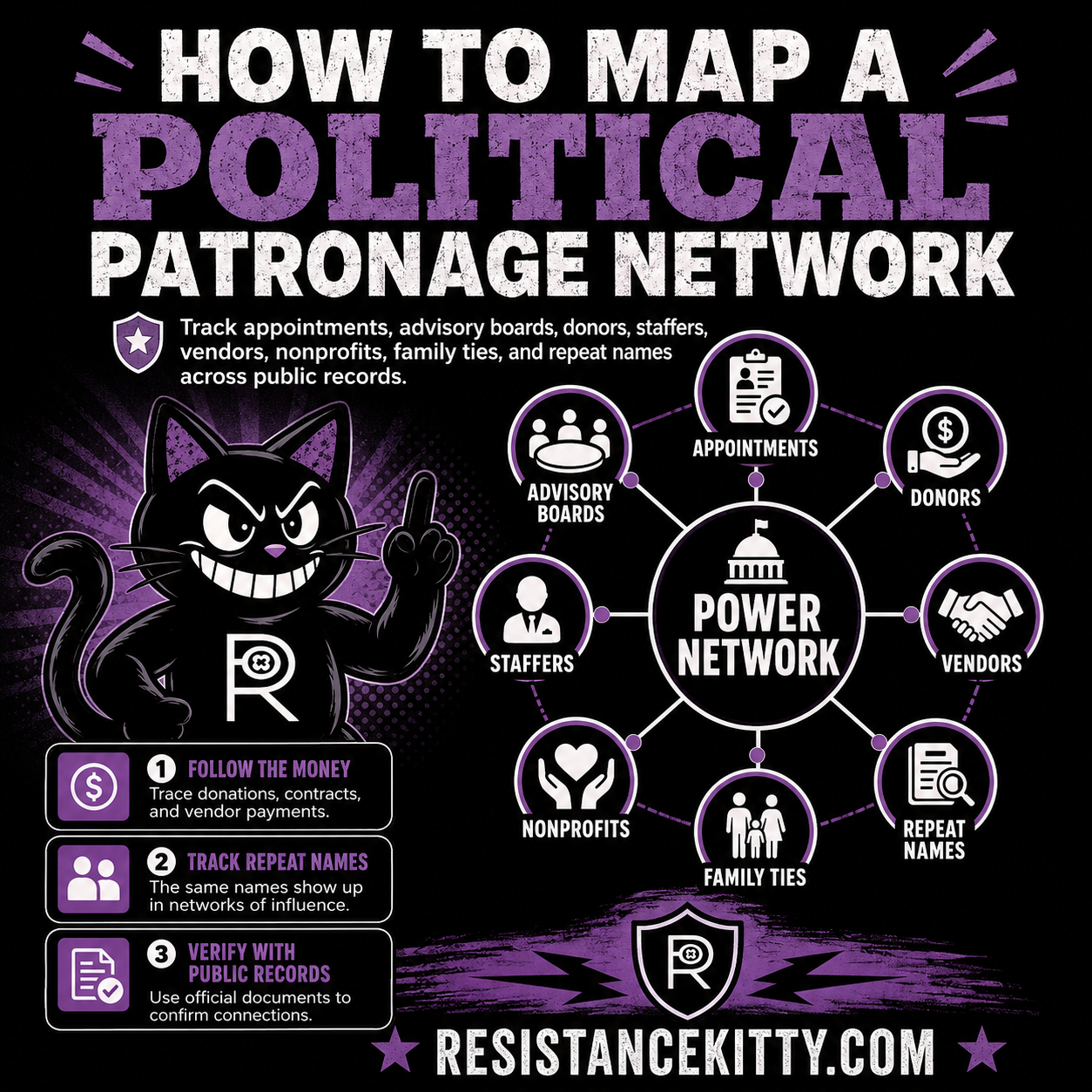
A patronage network is a power web. It can include elected officials, agency appointees, campaign donors, staffers, vendors, lobbyists, board members, consultants, nonprofit leaders, law firms, real estate interests, and family connections. One isolated connection may mean nothing. A repeated pattern across multiple public records is where the story begins.
The public should know when a donor later receives a contract. The public should know when a political appointee joins a board tied to regulated industries. The public should know when a nonprofit receives public money while sharing staff, vendors, or board members with political insiders. None of these facts automatically prove corruption. They are signals that deserve documentation, verification, and public scrutiny.
The strongest patronage maps are boring at first. That is a compliment. They start with names, dates, payments, appointments, filings, and meeting records. Then the pattern starts walking into the room by itself.
What You Are Looking For
A patronage map looks for repeated proximity to power. Track who gets appointed. Track who gets paid. Track who funds campaigns. Track who sits on boards. Track who lobbies. Track who appears in meeting minutes. Track who wins contracts. Track who creates nonprofits. Track who shares addresses, vendors, lawyers, treasurers, consultants, or registered agents.
The key is repetition. One donation is not a network. One appointment is not a system. One contract is not proof of favoritism. But the same names appearing across campaign finance, procurement, advisory boards, lobbying records, nonprofit filings, and public meetings may reveal a relationship structure that deserves deeper investigation.
Tools like LittleSis are built for this kind of power research. LittleSis describes itself as a free open source research platform and a database of relationships among powerful people in business and government. Map The Power also frames power research as a way to understand how relationships shape public policy and corporate influence.
Step by Step Guide
Step 1: Pick One Person, Agency, Or Decision
Start small. Choose one elected official, one agency, one board, one contract, one zoning decision, one public grant, or one advisory committee. Do not begin with the whole swamp unless you want to drown in spreadsheets while yelling at tabs.
Write the central question in plain language. For example, ask who benefited from this contract, who influenced this appointment, who funded this official, or who sits around this agency. A clear question keeps the map from becoming a conspiracy corkboard with printer ink issues.
Step 2: Build A Master Name List
Create a simple spreadsheet with columns for name, role, organization, record source, date, money amount, relationship type, link, and verification status. Add every person and entity connected to the target. Include elected officials, senior staff, donors, vendors, advisory board members, lobbyists, attorneys, consultants, nonprofit officers, corporate officers, and family names that appear in official records.
Do not merge names too quickly. Many people share names. Record middle initials, city, employer, occupation, address, and filing dates when the record provides them. Treat every match as unverified until at least two details line up.
Step 3: Track Appointments And Advisory Boards
Search official appointment pages, agency board rosters, committee records, meeting minutes, and advisory committee databases. At the federal level, the Federal Advisory Committee Act database is useful because GSA says it is used by agencies, Congress, the public, and media to monitor advisory committee activity. The FACA database can include committee costs, members, meetings, recommendations, and topic areas through its public data tools.
At the state and local level, look for boards and commissions pages, governor appointment announcements, county commission records, school board advisory groups, redevelopment authorities, pension boards, procurement committees, zoning boards, housing authorities, hospital boards, airport authorities, and ethics boards. These bodies often shape policy before the public realizes policy has been shaped.
Step 4: Follow The Money Through Campaign Finance Records
Search campaign finance records for donors, employers, occupations, PACs, committees, and repeat contribution dates. At the federal level, use the Federal Election Commission. For state races, judicial races, ballot measures, and state lobbying data, use FollowTheMoney and state campaign finance portals.
The FEC says individual contributor records can include name, occupation or employer, city, state, transaction date, contribution amount, and the committee receiving the contribution. FollowTheMoney says it provides 50 state campaign contributions, independent spending, and lobbying details for candidates, political parties, and ballot measures.
Do not just ask who donated. Ask when they donated. Did donations cluster before an appointment, vote, contract, rule change, budget decision, or zoning approval? Timing does not prove wrongdoing, but timing is often where the map starts getting interesting.
Step 5: Search Contracts, Grants, And Vendor Payments
Use USAspending for federal awards, contracts, grants, loans, and other spending. Search by recipient name, parent company, agency, location, award date, and keyword. USAspending identifies itself as the official open data source for federal spending information.
For state and local spending, search procurement portals, checkbook portals, county payment registers, school board contracts, city council agenda packets, bid tabs, award notices, purchase orders, emergency procurement lists, grant award lists, and audit reports. If the public body does not provide searchable data, request it.
This is where patronage can become visible. A vendor may donate to a campaign, place executives on advisory boards, hire former staffers, sponsor nonprofits, and then win public work. That still needs evidence and context. But it is exactly the pattern your map is built to test.
Step 6: Map Nonprofits, Foundations, And Civic Groups
Search nonprofit filings through the IRS Tax Exempt Organization Search and tools like ProPublica Nonprofit Explorer. The IRS search tool can be used to find tax exempt status and filings, including Form 990 series returns, determination letters, and automatic revocation records.
Look for board members, officers, key employees, grants, contractors, related organizations, and major program descriptions. Compare nonprofit officers to campaign donors, agency appointees, public vendors, lobbyists, and family names. Nonprofits can do important public work. They can also become convenient meeting rooms for power, money, and influence when nobody wants the connections on the front page.
Step 7: Check Lobbying And Revolving Door Records
Search federal, state, and local lobbying databases. At the federal level, use Senate lobbying disclosure records and OpenSecrets for lobbying and campaign finance research. OpenSecrets is a nonprofit transparency organization that tracks political money and lobbying, and the site includes tools for researching federal money in politics.
Look for former staffers who become lobbyists, lobbyists who become appointees, appointees who return to regulated industries, and consultants who appear across campaigns, nonprofits, and contractors. Revolving door records matter because access can be more valuable than a public title.
Step 8: Pull Business Records And Shared Addresses
Search state business entity databases through the secretary of state or corporation division in the relevant state. Business records can show officers, managers, registered agents, mailing addresses, formation dates, status, and filing history. For example, Florida Sunbiz allows searches by entity name, officer or registered agent, trademark owner, FEI or EIN, street address, and other fields.
Shared addresses are not automatic proof of coordination. They may indicate a law firm, accountant, coworking space, mail service, campaign vendor, or registered agent. Still, repeated shared addresses across PACs, vendors, nonprofits, and political committees are worth logging and verifying.
Step 9: Build The Relationship Map
Once the records are collected, turn the spreadsheet into a map. You can use LittleSis, a spreadsheet, a whiteboard, a simple table, or a visual mapping tool. Use clear relationship labels. Donated to. Appointed by. Employed by. Board member of. Contract awarded to. Lobbying client of. Registered agent for. Family connection to. Vendor for. Paid by.
Keep the relationship language precise. Do not write connected to when you can write donated 1,000 dollars on March 4, 2026. Do not write tied to when you can write board member from 2023 to 2025. Vague language makes your research weaker. Specific language makes the receipts do the talking.
Step 10: Fact Check Before Publishing Or Sharing
Before publishing, check each claim against the original record. Save clean links. Download PDFs when allowed. Archive important pages. Screenshot only when necessary, and keep the source URL with the screenshot. Mark uncertain matches as uncertain. Separate facts from interpretation.
The safest wording is evidence based. Say the records show. Say public filings list. Say campaign finance data reports. Say meeting minutes identify. Avoid saying bribery, payoff, corruption, or illegal unless there is a legal finding, charge, admission, or court record to support that word. The map can be powerful without overclaiming. Actually, it is more powerful when it does not overclaim.
Red Flags Worth Tracking
Watch for repeat donors who later receive appointments, contracts, grants, or board seats. Watch for vendors that appear in campaign spending records and public procurement records. Watch for consultants who work for campaigns and later show up in government communication contracts. Watch for appointees who regulate industries where they recently worked. Watch for nonprofits that receive public money while sharing officers, funders, vendors, or addresses with political insiders.
Also watch for emergency contracts, short bid windows, sole source justifications, vague scopes of work, repeated contract amendments, sudden nonprofit formation before a grant, board resignations before a vote, and agency staff moving into private roles with companies they once oversaw. Those facts do not automatically prove misconduct. They do tell you where to keep digging.
Practical Safety Rules
Keep your research factual and boring on purpose. Do not harass private individuals. Do not contact family members. Do not publish home addresses. Do not dox low level employees. Do not turn public records research into a pile on. The goal is accountability, not chaos cosplay.
When sharing a patronage map, include source links and explain what the map does and does not prove. Be careful with common names. Be extra careful with family relationships. Verify marriages, relatives, business partners, and employment history through reliable public records before treating them as meaningful.
Use public records requests when information is missing. MuckRock helps users file, track, and share public records requests, while NFOIC provides open government resources through state and regional affiliates.
Independent Research Sources To Use
Use official records first, then independent watchdogs and nonprofit investigative outlets for context. Useful sources include MuckRock, Project On Government Oversight, ProPublica, LittleSis, FollowTheMoney, OpenSecrets, NFOIC, and Documented.
For Resistance Kitty readers, pair this guide with the Resistance Directory when building a local watchdog toolkit, and keep the Resistance Kitty archive handy for related survival guides on public records, government agendas, ethics complaints, and power mapping.
Key Takeaways
- A patronage map is not a rumor board. It is a public records system.
- The strongest evidence comes from repeated names across appointments, donations, boards, lobbying, contracts, grants, nonprofits, and meeting records.
- Campaign finance records show who funded political committees, but they must be compared with dates, decisions, contracts, and appointments before drawing conclusions.
- Advisory boards matter because they often shape policy before the public hears about the policy.
- Nonprofit filings matter because boards, grants, contractors, and related organizations can reveal influence networks that campaign records miss.
- Vendor records matter because public money is often where political favor becomes measurable.
- The goal is not to prove a theory. The goal is to organize verified facts until the pattern can be tested.
In Closing
Political patronage survives in clutter. It hides inside agenda packets, donor lists, advisory boards, procurement portals, nonprofit filings, and meeting minutes that most people are too exhausted to read. That is the trick. The antidote is patient mapping. Pick one person, one agency, one contract, or one decision. Track the names. Log the dates. Follow the money. Verify every claim. Then show the public the structure of power without turning the work into noise. Corruption hates clean spreadsheets almost as much as it hates sunlight.
Source List
- Federal Election Commission campaign finance data
- FEC individual contributions guide
- USAspending
- Federal Advisory Committee Act database
- GSA FACA database overview
- IRS Tax Exempt Organization Search
- IRS search for tax exempt organizations
- ProPublica Nonprofit Explorer
- LittleSis
- Map The Power
- FollowTheMoney
- OpenSecrets
- MuckRock FOIA 101
- National Freedom of Information Coalition
- Project On Government Oversight
- ProPublica
- Florida Sunbiz public records search
- Resistance Directory
- Resistance Kitty