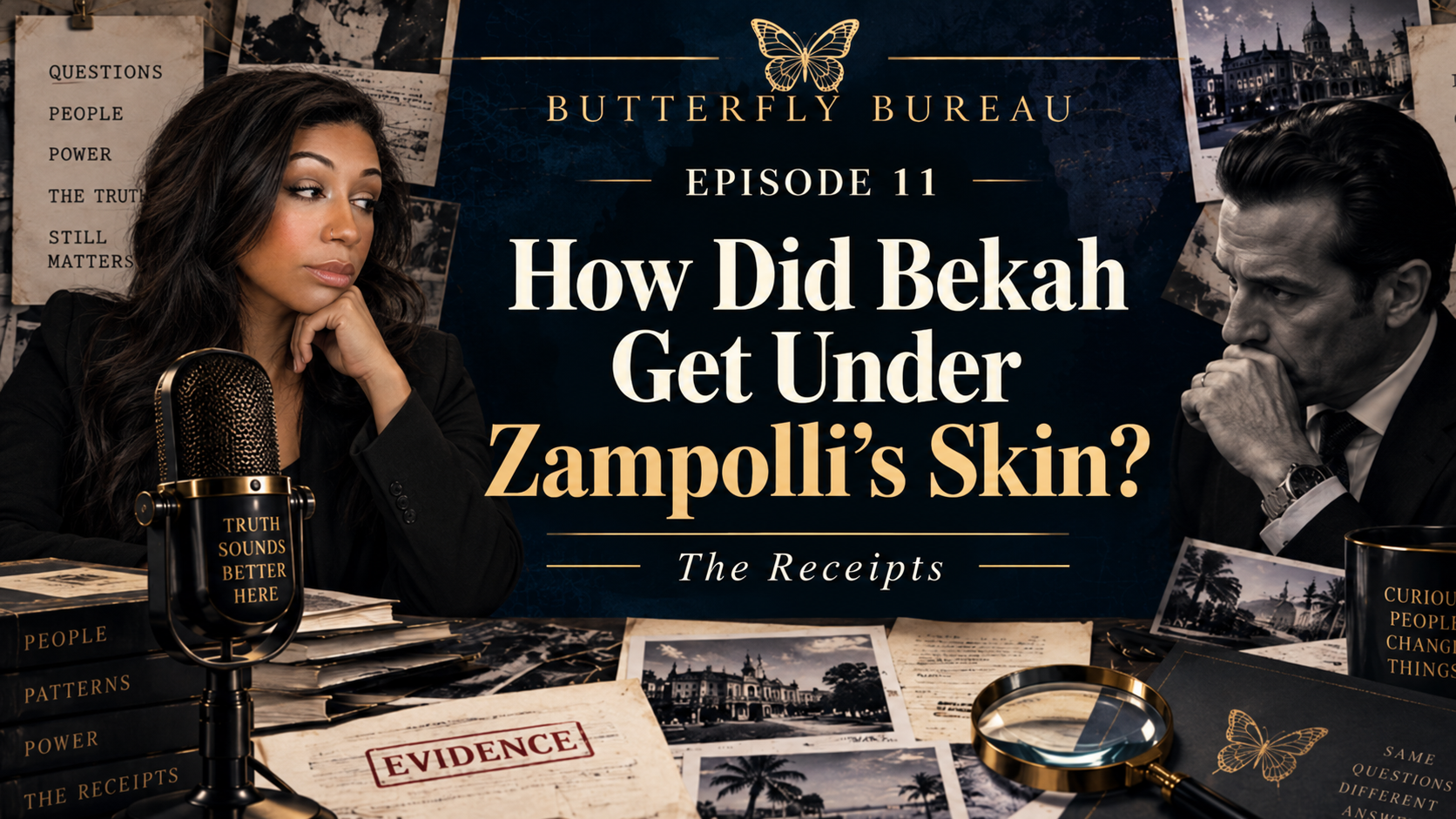
The Butterfly Bureau Receipts: Bekah Day confronted Paolo Zampolli. We unpacked the interview, the deflections, the uncomfortable questions, and the documentary trail that makes this story impossible to ignore.
The Interview That Had Us Talking
Well, butterflies, this was one hell of a conversation to unpack.
On October 7, 2026, investigative journalist Bekah Day appeared on The Bad Decisions Podcast with Scott Michael Nathan, where she finally had the opportunity to question Paolo Zampolli directly.
Not through a press release. Not through a carefully prepared statement. Not through somebody’s attorney.
Face to face, virtually, with microphones recording.
Zampolli is a former modeling executive, longtime associate of Donald Trump, and presidential special envoy. He also appears in records and reporting involving Jeffrey Epstein’s modeling industry connections.
Bekah had been investigating him since July 2025. So when she got her opportunity to ask questions, she arrived with more than curiosity.
She had documents.
For Episode 11 of The Butterfly Bureau, we examined this remarkable confrontation, processed the exchanges, and considered what happens when a determined independent investigator starts asking questions that powerful people would rather not answer.
And because we’re The Butterfly Bureau, we’re not going to leave you with reactions alone.
We’re bringing the receipts.
The Interview: What Actually Happened?
In the October 7 interview, Bekah and Zampolli discussed Jeffrey Epstein, the modeling business, disputed personal allegations, Ghislaine Maxwell, and Zampolli’s relationships with influential figures.
Throughout the conversation, Zampolli challenged Bekah’s interpretations and disputed several allegations. At other moments, he acknowledged associations or business dealings that deserved closer examination.
In her October 9 firsthand account, Bekah described preparing for the interview and her impressions afterward.
She explained that her investigation had begun with questions about how Donald Trump met Melania, before expanding into the relationships connecting Zampolli, Epstein, the modeling industry, and politically influential people.
The most interesting aspect of the conversation was not simply whether Zampolli became irritated.
It was how his answers compared with records that already existed.
That became the central question for our discussion: What did the interview reveal, and what did it leave unanswered?
The Modeling Industry and Epstein’s Access to Young Women
One of the most important subjects Bekah raised was Epstein’s access to models and modeling agencies.
The July 2019 FBI interview record, EFTA00090773, includes statements from a former model describing her experience in the modeling industry, Epstein’s visits to an agency, and encounters involving people associated with that business.
These statements deserve examination because Epstein’s exploitation did not occur in a vacuum.
He cultivated relationships across industries where powerful individuals could influence careers, housing, travel, introductions, and opportunities.
For aspiring models, especially young women arriving in unfamiliar cities, those power imbalances could be substantial.
The FBI document establishes that these statements were made to investigators. It does not independently prove every detail or establish that Zampolli knowingly facilitated Epstein’s crimes.
But it gives investigators a concrete record against which to test later explanations.
Our question: How much did modeling industry insiders actually know about Epstein’s interest in the young women moving through their professional circles?
The Elite Models Business Deal
Perhaps one of the most consequential subjects involved the attempt by Epstein and Zampolli to acquire Elite Model Management.
The EpsteinWiki interview investigation examines the reported negotiations and Zampolli’s descriptions of his relationship with Epstein.
During the interview, Zampolli described Epstein as a rival in the modeling industry, but also discussed a proposed arrangement involving Epstein’s money and Zampolli’s management expertise.
An acquisition proposal is not evidence of trafficking.
Nevertheless, a business relationship involving one of the world’s most influential modeling agencies deserves careful scrutiny when one of the prospective participants was Jeffrey Epstein.
We want to know what documents survive from the negotiations, what their respective roles would have been, and whether the proposal would have expanded Epstein’s access to models.
Those are investigative questions, not conclusions.
And those questions existed before Bekah ever turned on her microphone.
Ghislaine Maxwell, TerraMar, and the Familiar Social Circle
The interview also moved into Zampolli’s connections with Ghislaine Maxwell.
Maxwell was convicted in federal court in 2021 for crimes connected to Epstein’s abuse and trafficking of minors.
Her TerraMar Project publicly promoted ocean conservation while cultivating relationships with influential people and institutions.
Historical TerraMar materials documented relationships involving Zampolli’s diplomatic and ocean advocacy circles.
The EpsteinWiki review of Maxwell correspondence distinguishes between publicly archived TerraMar material and correspondence obtained from a private email archive.
That distinction matters because documents from different sources carry different authentication questions.
During the interview, Zampolli acknowledged knowing Maxwell and discussed possible communications, while denying knowledge of important aspects of her relationship with Epstein.
Those answers are worth comparing with the historical correspondence.
Knowing Maxwell does not establish participation in her crimes. But the extent, timing, and nature of their relationship remain legitimate subjects of investigation.
When Epstein Himself Had Something to Say About Zampolli
Here’s an especially interesting twist.
In EFTA00642630, February 2011 correspondence between Epstein and Sultan Ahmed bin Sulayem references Zampolli and an anticipated dinner.
Epstein warns Sulayem about him and subsequently alleges that Zampolli sold stories to the media.
This is a useful reminder that Epstein’s network was not one giant friendship club.
People within that world could cooperate, compete, exchange favors, and distrust one another.
During Bekah’s interview, Zampolli treated Epstein’s warning as evidence of their antagonistic relationship.
But what should we make of someone being both a former prospective business partner and a person Epstein later criticized?
Neither fact cancels the other.
The documents invite us to reconstruct how the relationship developed over time, rather than treating it as either a lifelong friendship or complete estrangement.
Amanda Ungaro and the Questions That Remain
The discussion became particularly serious when Bekah raised allegations involving Amanda Ungaro, Zampolli’s former partner and the mother of his child.
Ungaro has made serious public allegations concerning her experiences with Zampolli. He has denied allegations of abuse.
In the reporting examined by EpsteinWiki, the interview is assessed alongside historical reporting, relationship timeline questions, and references to Epstein flight records.
The details matter.
A person’s name appearing in a flight record does not establish that a crime occurred. A disputed relationship timeline cannot be settled through speculation. And allegations of violence require careful attribution and corroboration.
But allegations involving possible abuse of power should not be dismissed simply because the person answering the questions has influential friends.
For The Butterfly Bureau, survivor-centered reporting means taking allegations seriously while protecting the distinction between what a person reports and what the independent evidence establishes.
We can do both.
We should do both.
The TikTok Question
Bekah also questioned Zampolli about restrictions affecting her TikTok account.
She wanted to know whether he had been responsible.
He denied causing the restriction.
The timing of a platform action, no matter how suspicious someone considers it, is not sufficient evidence to identify who caused it.
Nevertheless, their exchange opened a larger discussion about what independent investigators face when reporting on powerful people.
The threat of legal action, public criticism, reputational pressure, and account restrictions can have enormous consequences for journalists who operate without the institutional protections of large media companies.
None of that establishes Zampolli’s involvement in Bekah’s account restriction.
What it does establish is why protecting the ability to ask evidence-based questions matters.
What Made This Interview So Compelling?
One of the things we wanted to process in Episode 11 was the dynamic between an independent investigator and someone accustomed to navigating powerful professional circles.
Bekah had spent months researching the documentary record before she questioned Zampolli.
She wasn’t simply reacting to a viral accusation.
She had studied names, timelines, federal investigative records, news reports, and correspondence.
Zampolli, for his part, did not simply remain silent. He offered explanations, disputed allegations, and challenged Bekah’s reporting.
That makes the interview useful.
The public has access to both the questions and the responses.
And when a response conflicts with another source, we can go back to the documents rather than treating either person’s confidence as proof.
The most valuable investigative interviews don’t always produce admissions.
Sometimes they produce more precise questions.
Sometimes they reveal where timelines need work.
Sometimes they show that a relationship was more complicated than the public previously understood.
And sometimes the most significant result is simply getting a person’s account on the record.
What We Still Want Answered
The EpsteinWiki follow-up investigation identifies several unresolved evidentiary questions raised by the confrontation.
Among them are the identities and consent of models whose portfolios were reportedly distributed, the details of the unsuccessful Elite acquisition, the provenance of Maxwell-related private emails, and how to reconcile disputed relationship timelines with dated records.
We also want to understand the full scope of Epstein’s interactions with modeling agencies and the people who managed them.
These are not insignificant details.
They go directly to the mechanisms through which Epstein obtained access, built relationships, and operated in plain sight.
We should resist the temptation to fill missing evidence with assumptions.
There is already plenty to investigate.
Why We Dedicated Episode 11 to This Interview
Because the Epstein story is not finished.
Not when records remain unexplored.
Not when survivors and witnesses continue to raise questions.
Not when powerful relationships remain incompletely documented.
And certainly not when investigative journalists are still discovering records that complicate the stories people have told about their own involvement.
Bekah’s interview was an opportunity to examine what happens when an independent investigator directly confronts someone she has spent months researching.
Our job at The Butterfly Bureau was to unpack that moment, consider the responses, and bring our audience back to the evidence.
We don’t need to declare someone guilty to ask hard questions.
We don’t need to agree with every interpretation to recognize the value of the investigation.
And we don’t need to accept a public figure’s explanation without checking it against what the records actually say.
That’s why we keep the receipts.
The Butterfly Bureau’s Final Thoughts
At the heart of Episode 11 is a simple idea: accountability begins with questions, but it requires evidence.
Bekah got the interview.
Zampolli gave his answers.
Now those answers belong to the public record, alongside the FBI interviews, correspondence, historical reporting, and other material that investigators can continue to examine.
And as more documents emerge, those answers can be tested again.
That is the power of independent investigative work.
Not the loudest accusation. Not the most dramatic social media clip. Not the most politically connected person in the room.
The evidence. Always the evidence.
Keep asking questions, butterflies.
And keep following the receipts.
Watch the Episode and Follow the Evidence
The Butterfly Bureau: Visit our podcast and investigation home
Original interview: Watch Bekah Day question Paolo Zampolli
Bekah’s account: I Confronted Paolo Zampolli: Here’s What Happened
Interview evidence review: EpsteinWiki’s complete sleuth report
Follow-up document analysis: EpsteinWiki examines Bekah’s written account
Primary Epstein records: Search the Epstein Data archive
1 thought on “Episode 11: How Did Bekah Get Under Zampolli’s Skin?”