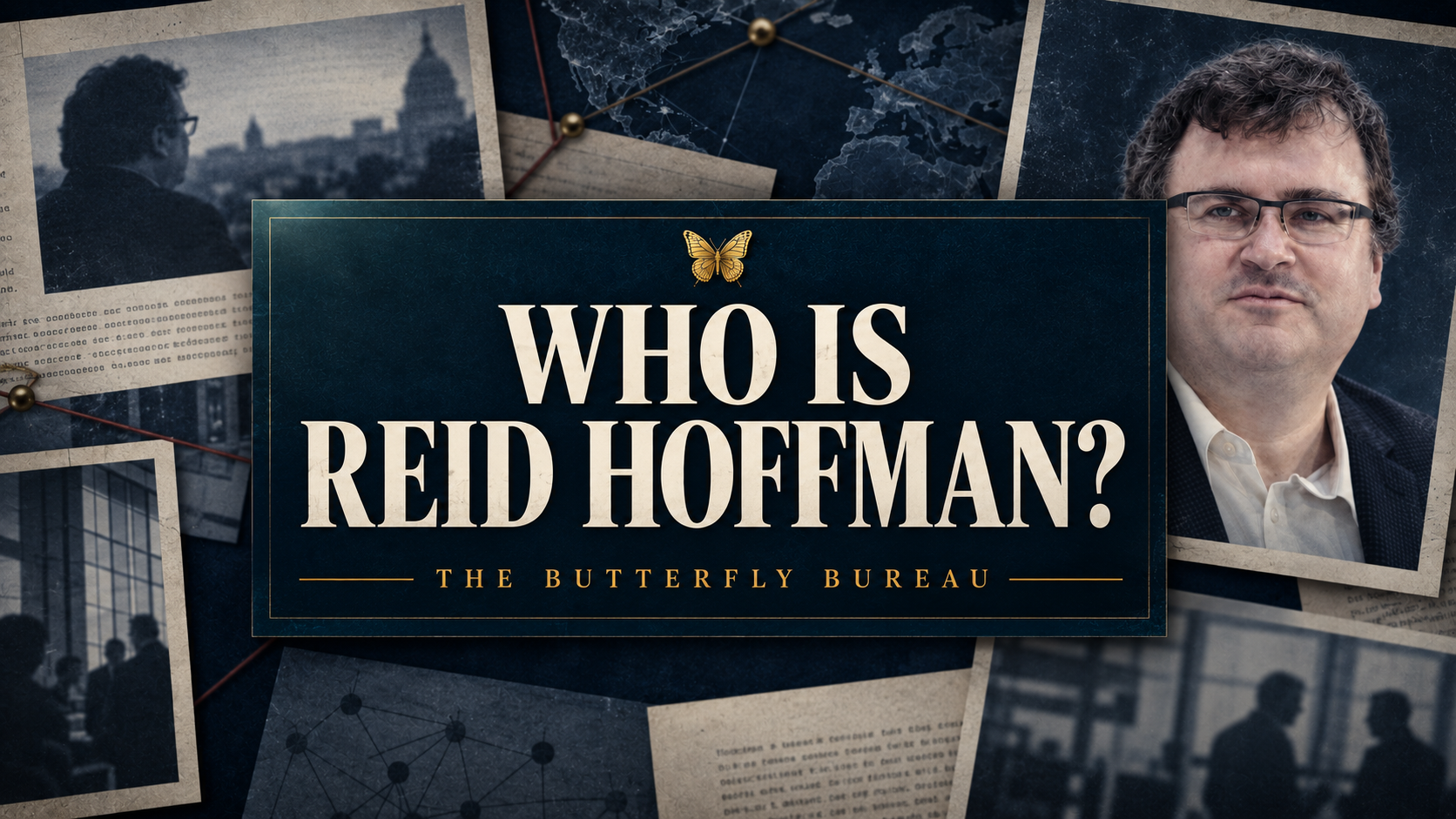
In Episode 9 of the Butterfly Bureau, Resistance Kitty, Night Fire, and Dr. Chenoweth asked a question that sounds simple until the receipts start piling up: Who is Reid Hoffman, and what was the real nature of his relationship with Jeffrey Epstein?
This is the companion receipts blog for that conversation. It is not a transcript and it is not a prosecution brief. The episode examined Hoffman from three directions: the human being, the political power broker, and the person who appears in Epstein’s records. The documents below let you check the discussion for yourself.
This is not a story claiming that every wealthy man in Epstein’s calendar participated in his crimes. A name in an email is not a conviction. A visit to Little Saint James does not, by itself, prove sexual misconduct. The records reviewed for this article do not establish that Hoffman sexually abused or trafficked anyone.
But that evidentiary boundary does not make the documented relationship insignificant.
The records show that Hoffman’s association with Epstein was not a random address book entry or one uncomfortable meeting arranged by MIT. It was a recurring, socially useful, post conviction relationship involving travel, an overnight island visit, gifts, dinners, introductions, discussion of Epstein’s press problems, and contacts that continued through 2018.
That is not proof of participation in Epstein’s sexual crimes. It documents Epstein’s continued access to elite technology, academic, philanthropic, and political networks after his conviction. The records do not, by themselves, establish each participant’s motives.
As we say at the Butterfly Bureau, this is not entertainment. This is documentation.
What Episode 9 Was Really Asking
The easy version of this story has only two possible answers. Either Hoffman was an innocent fundraiser who made a regrettable mistake, or he was secretly part of Epstein’s criminal enterprise.
Those labels are not a substitute for reading the records.
The episode instead asked how proxy trust, elite culture, ambition, money, and social networking can keep a dangerous person inside respectable institutions. Joi Ito appears to have been the primary bridge. Hoffman trusted Ito. MIT gave the relationship an institutional purpose. Epstein offered money, access, intellectual excitement, and a network of people who made one another feel important.
That combination can explain conduct without excusing it.
The relationship visible in the cited records appears warmer than a reluctant donor solicitation. The records show periodic interactions, sometimes with Ito or other academics and sometimes through direct exchanges, but do not establish the full frequency or intimacy of the relationship.
That distinction matters. The episode did not identify evidence that Hoffman was part of Epstein’s inner operational circle. It identified a powerful connector who exercised poor judgment, extended legitimacy, and did not look hard enough at a man whose conviction and surrounding allegations were already public.
Who Is Reid Hoffman?
Reid Garrett Hoffman is the billionaire cofounder of LinkedIn. He was a senior executive at PayPal, became a partner at the venture capital firm Greylock, cofounded the artificial intelligence company Inflection AI, and served on Microsoft’s board.
His power is not limited to money. Hoffman connects technology founders, investors, politicians, academics, philanthropists, and institutions. He can open rooms that most people never even learn exist.
That is why his relationship with Epstein matters. Epstein collected more than wealthy acquaintances. He collected doors. Hoffman was a very expensive door.
Hoffman is also a major Democratic donor and a prominent opponent of Donald Trump. That political context has created two equally sloppy reactions. Trump allies often treat Hoffman’s appearance in the files as automatic proof of criminal conduct. Some Democrats treat scrutiny of Hoffman as partisan propaganda that can be ignored.
Both positions fail the evidence test. A receipt does not become fake because Trump weaponizes it. An accusation does not become true because a politician repeats it.
The MIT Doorway
MIT’s independent investigation found that Jeffrey Epstein gave MIT ten donations totaling $850,000 between 2002 and 2017. Nine of those donations, totaling $750,000, came after his 2008 conviction. Six Media Lab donations made between 2013 and 2017 totaled $525,000.
The institutional bridge between Hoffman and Epstein was Joi Ito, then director of the MIT Media Lab. Hoffman has said Ito brought him into contact with Epstein for MIT fundraising and that he believed MIT had vetted Epstein.
That explanation is partly supported. Ito appears throughout the records, and many of the meetings involved MIT figures, academic projects, or fundraising discussions. But institutional purpose does not explain every personal choice that followed.
It does not explain why Hoffman asked about Epstein’s island, stayed there overnight, sent gifts, offered to help with bad press, used friendship language, introduced Epstein to Mark Zuckerberg, or continued having meetings and calls years after the relationship supposedly ended.
MIT explains the doorway. It does not explain away what happened after Hoffman walked through it.
The Receipts
The EFTA links below open public mirror copies of the released documents.
EFTA00386874: The 2013 MIT Meeting
A calendar alert dated July 29, 2013 lists a July 19 meeting with Neil Gershenfeld and Reid Hoffman. MIT’s independent report confirms that Hoffman met Epstein on campus with Ito and Gershenfeld, with Megan Smith joining part of the meeting.
This supports Hoffman’s statement that MIT was the institutional connection. It also marks the beginning of a relationship that soon moved well beyond an ordinary campus fundraising meeting.
EFTA00970605: Hoffman Asks About the Island
On September 12, 2013, Hoffman directly asked Epstein when he would be at the island. Epstein replied that the island was available after October 15.
This exchange does not prove Hoffman traveled there in 2013. It proves that private island travel had already become part of their direct conversation only months after the documented MIT meeting.
EFTA00985688: The New Mexico Ranch Invitation
In March 2014, Epstein invited Hoffman to his New Mexico ranch after a Joi Ito event. The document shows an invitation and planning. It does not independently prove Hoffman completed that visit.
That distinction matters. Invitations prove access was offered. They do not prove the trip happened.
EFTA00362236: The Island Route
In a September 17, 2014 exchange planning a November trip, Epstein described Hoffman flying to Fort Lauderdale, being picked up by car, and joining a jet flight to St. Thomas followed by a helicopter trip to the island. Hoffman responded that the plan worked for him.
This was not a surprise layover or an accidental stop. The visit was planned.
EFTA00362228: The Planned Overnight Stay
A September 17, 2014 logistics email described a proposed trip for Joi Ito and Hoffman to visit the island on November 28 or 29, stay overnight, and fly to Boston on November 30.
The overnight plan is important because it was more than a proposed brief professional encounter. The email documents planned travel to Epstein’s private island with lodging built into the itinerary; it does not by itself establish that the trip occurred.
EFTA00358172: Passport Coordination for the Flight
A November 24, 2014 forwarding email includes Hoffman’s assistant’s November 20 response to a request for his passport details, which the requester said the pilot needed to fly him. The forwarding email lists a passport PDF attachment.
This is concrete travel-administration evidence, not merely an invitation. It documents passport coordination for a planned flight, but does not by itself prove that the pilot received the information or that Hoffman boarded the aircraft.
EFTA02300458: Hoffman on Little Saint James
On November 29, 2014, Karyna Shuliak sent an email listing Joi, Reid Hoffman, Jeffrey, and others as currently on Little Saint James.
This is the strongest direct confirmation of Hoffman’s presence on the island. The email establishes presence. It does not establish sexual misconduct. Those are different claims, and responsible investigators do not blur them.
Presence still matters. Hoffman chose to visit the private island of a convicted sex offender and stay overnight. The ethical question does not disappear because the available evidence stops short of proving another crime.
EFTA00357882: From the Island to Boston
A November 29, 2014 email carries the next day’s schedule: travel from Little Saint James to the Boston area and a dinner listing Hoffman, Joi Ito, George Church, Martin Nowak, Larry Summers, Danny Hillis, and others. The schedule alone does not prove that every listed person attended.
A related itinerary in EFTA02301105 lists the November 30 dinner at Martin Nowak’s office and a later private meeting with Larry Summers.
This is Epstein’s ecosystem compressed into one itinerary: a private island, private aviation, elite science, Harvard, MIT, venture capital, and political influence moving together. Epstein’s most valuable product was not financial brilliance. It was proximity, legitimacy, and the ability to make powerful people useful to one another.
EFTA01003545: Christmas Gifts and “The Girls”
On December 24, 2014, Hoffman told Epstein that he had sent two gifts to his New York address, including ice cream for Epstein to try or, if he was not interested, for “the girls.” He also said he hoped Epstein was having fun as usual.
The wording is disturbing in context, but the document does not prove that Hoffman meant minors. A Hoffman spokesperson said the phrase referred to adult members of Epstein’s team who called themselves “the girls.”
What the email does establish is a familiar, comfortable social tone shortly after the island visit. It does not read like the strained correspondence of a reluctant fundraiser tolerating a donor at MIT’s request.
EFTA00674139: The Offer to Help With Epstein’s Press
On January 8, 2015, Hoffman told Epstein that he had been thinking about how he could help with recent press, particularly “on the online front.”
The email establishes an offer to consider helping Epstein with recent press, particularly online. It does not identify a specific article or establish what work, if any, was ultimately performed.
Hoffman still owes the public a direct answer. What did he propose, and did he, his employees, a consultant, or any company take action on Epstein’s behalf?
EFTA00344564: The Palo Alto Dinner
A July 31, 2015 email chain planning an August 2 dinner at Baume Restaurant in Palo Alto lists Hoffman, Epstein, Mark Zuckerberg, Priscilla Chan, Peter Thiel, Elon Musk, Joi Ito, and others.
A guest list alone cannot prove that every listed person attended. Later correspondence supports interaction between Hoffman and Epstein at the dinner. In a 2024 written Senate response, Meta stated that Zuckerberg met Epstein once in passing at a scientists’ dinner and did not communicate with him afterward.
This is why we follow individual receipts. A planning document is not permission to draw a friendship line between every name on the page.
EFTA01205269: “Your Friendship”
After the dinner, Epstein thanked Hoffman for the event, a gift, and his friendship. Hoffman replied that it had been very fun talking with Epstein and offered to introduce him to Mark Zuckerberg.
The tone is friendly and socially useful. It is not hostile, distant, or merely administrative.
EFTA01789503: The Zuckerberg Introduction
On August 5, 2015, Hoffman emailed Epstein and Zuckerberg to connect them so their dinner conversation could continue.
That is active network brokerage. Hoffman used his personal credibility to extend Epstein’s access to another major technology leader. The email does not establish wrongdoing by Zuckerberg. It establishes what Hoffman did with the introduction.
EFTA01198859: Another Island or Ranch Invitation
On September 6, 2015, after Hoffman said he probably would not be in New York for the General Assembly/Clinton events and that the following year was possible, Epstein invited him to the island or ranch. This record contains no subsequent reply from Hoffman accepting that invitation.
This is another invitation, not proof that another trip occurred. It does show that direct social contact continued.
EFTA02052120: Epstein Reports Finding Hoffman’s Passport
An April 27, 2016 email addressed in its body to Hoffman’s assistant reports that Epstein had found Hoffman’s passport in a pocket of a bag Hoffman had given him and planned to return it in Cambridge.
The document does not establish when the passport entered the bag or how long Epstein had it. It does document continued shared logistics and planned contact in April 2016.
EFTA02394020 adds direct dinner coordination, with Hoffman asking whether dinner with Joi would include Larry or only Epstein. Epstein replied that it would include Larry, himself, and the passport.
EFTA00997595: Praise, Introductions, and Bitcoin
In a September 2014 email thread initiated by Epstein to introduce Hoffman and diplomat Hardeep Singh Puri, Hoffman praised Epstein’s taste in people, discussed meeting Puri, and raised a Bitcoin-related contact with Epstein.
This matters because it shows Hoffman doing more than attending events. He praised Epstein’s judgment while participating in an introduction. That is evidence of social endorsement; the exchange alone does not establish its wider effect on Epstein’s reputation.
The 2019 Story Did Not Hold
In his September 2019 statement to Axios, Hoffman described only a few interactions with Epstein, said they occurred at Ito’s request for MIT fundraising, and said his last interaction with Epstein took place in 2015.
He also apologized. Hoffman acknowledged that his participation helped repair Epstein’s reputation and perpetuate injustice. That admission matters.
The end date was wrong.
In his February 2026 public correction, Hoffman said an additional calendar review uncovered six contacts after 2015:
- An April 8, 2016 meeting in Palo Alto
- An April 29, 2016 meeting with Joi Ito in Cambridge
- A June 20, 2016 Skype call
- A June 25, 2016 Skype call
- A July 24, 2016 meeting with Joi Ito and Martin Nowak in Cambridge
- A March 24, 2018 Skype call with Joi Ito
Hoffman said all six contacts were coordinated by Ito and concerned MIT fundraising. That may describe their institutional purpose. It does not explain why his first public chronology omitted three meetings and three calls spanning several years.
One forgotten appointment can be a mistake. Six omitted contacts require a better explanation and a complete record review.
When Two Connectors Meet
One of the most useful observations in Episode 9 came from looking at Hoffman and Epstein as two people who understood the value of networks.
LinkedIn turned professional connection into a business model. Epstein turned elite connection into social currency, protection, and power. Both men understood that access to one valuable person could unlock ten more.
That does not prove they shared the same motives or morality. It helps explain why they were useful to one another.
In EFTA00997595, Hoffman praised Epstein’s taste in people while participating in an introduction. In EFTA01789503, Hoffman directly connected Epstein with Mark Zuckerberg. In EFTA00674139, Hoffman offered to think about helping with Epstein’s recent press on the online front.
Those records show the value Hoffman could provide. He could validate Epstein’s judgment, widen his network, and potentially help with the “Google problem” that followed Epstein’s name after his conviction.
The episode also discussed more ambiguous material involving a “deception group,” references to “the pen,” and the social language of an inner circle. Those records deserve a separate document review before anyone turns them into a claim about a secret society or covert operation. Interesting language is a lead. It is not automatically a conclusion.
Hoffman’s Support for Survivors Also Belongs in the Record
The episode did not ignore facts that complicate a clean villain narrative.
Hoffman has repeatedly called for disclosure of the Epstein files with survivor identities protected. On November 17, 2025, he publicly acknowledged supporting the airing of World Without Exploitation’s Monday Night Football advertisement calling for release of the files. That campaign featured survivors.
This support does not erase his earlier association with Epstein. It also should not be erased merely because Hoffman is politically inconvenient to people investigating the network.
The exact amount, conditions, and structure of Hoffman’s support for the advertisement were not publicly disclosed in the materials we reviewed. The evidence also does not establish that Hoffman funded the separate 2026 Super Bowl advertisement.
Accountability can hold two facts at once. Hoffman helped normalize Epstein after his conviction, and Hoffman later supported advocacy demanding disclosure and greater attention to survivors.
The James Talarico Smear Does Not Follow the Money
The Texas Tribune documented that Hoffman gave a combined $11.5 million to Lone Star Rising, the Super PAC supporting Texas Democrat James Talarico in 2026.
That makes Hoffman a major political funder of the effort. It does not make Talarico funded by Jeffrey Epstein.
No evidence reviewed for the episode showed that Epstein supplied the money Hoffman contributed to Lone Star Rising. No evidence showed that Talarico participated in Hoffman’s relationship with Epstein. Describing the political support as “Epstein money” skips the financial chain the claim would require.
A candidate can reasonably be questioned about a billionaire donor. A donor’s documented association with Epstein can also be investigated. But guilt does not travel backward through time and then forward through an unrelated political contribution simply because the resulting slogan performs well online.
This is the partisan trap discussed in the episode. Hoffman’s opposition to Trump does not erase his Epstein contacts. His Epstein contacts do not convert every later political donation into Epstein funding.
What the Evidence Establishes
- Hoffman had repeated contact with Epstein after Epstein’s 2008 conviction.
- Joi Ito and MIT fundraising were a central institutional bridge.
- Hoffman planned and completed an overnight visit to Little Saint James in November 2014.
- The relationship included gifts, dinners, friendly correspondence, and social introductions.
- Hoffman offered to consider helping Epstein with recent press on the online front.
- Hoffman introduced Epstein to Mark Zuckerberg after a private dinner.
- Contacts continued through March 2018, several years beyond the end date Hoffman gave in 2019.
- Hoffman has expressed regret and acknowledged that his association helped repair Epstein’s reputation.
What the Evidence Does Not Establish
- The records reviewed do not establish that Hoffman participated in Epstein’s sexual abuse or trafficking.
- They do not establish that Hoffman knew the full scope of Epstein’s crimes.
- They do not establish sexual misconduct during Hoffman’s island visit.
- They do not prove that every proposed meeting, invitation, or trip occurred.
- They do not prove that every person listed on the Palo Alto dinner sheet attended.
- They do not establish that Hoffman completed any online reputation work for Epstein.
- They do not support calling Hoffman an Epstein coconspirator or “client.”
- No public survivor accusation, sexual misconduct lawsuit, settlement, or identified nondisclosure agreement involving Hoffman was located in the evidence review.
- The records do not establish that Hoffman belonged to Epstein’s inner operational circle.
- They do not establish that Hoffman’s political donations were Epstein’s money.
- They do not connect James Talarico to Epstein.
Why This Relationship Matters
Epstein did not need every powerful associate to join his criminal operation. He needed respected people to keep treating him as acceptable.
Sometimes elite protection looks like a secret agreement. More often, it looks ordinary. It looks like fundraising. A private dinner. A helicopter ride. An overnight stay. A Christmas gift. A helpful email about bad press. An introduction to someone even more powerful.
Each act tells the surrounding institution that the convicted offender is still welcome, still useful, and still safe to know. That is how reputations are laundered without anyone signing a document labeled “reputation laundering.”
Survivor centered reporting asks more than whether an associate committed a chargeable crime. It asks how wealth, prestige, proxy trust, and institutional access allowed Epstein to rebuild legitimacy after survivors had already told the truth.
Episode 9 also confronted a less comfortable question. What happens when a friend or trusted colleague tells you that the conviction was unfair, the accuser lied, or the conduct was misunderstood? Most people do not immediately abandon someone they trust. They listen to the version of events they are emotionally prepared to believe.
That human tendency becomes more dangerous inside a culture where wealth reduces consequences, powerful men routinely dismiss women’s accounts, and sexual access to much younger women is treated as a status symbol. Understanding that mechanism is not the same as excusing it. It helps explain how dozens of intelligent people could keep Epstein inside their social world while convincing themselves they were not doing anything wrong.
The relevant difference is that Epstein was not merely accused. He had pleaded guilty to two state felony offenses, including procuring a person under eighteen for prostitution. By the years covered in these records, additional survivor accounts and litigation were also public. Hoffman did not need secret intelligence to know that deeper scrutiny was warranted.
The anger belongs with Epstein, the institutions, and the powerful adults who normalized him. It never belongs with survivors, and survivors should not have to reconstruct the network for us.
Questions Reid Hoffman Still Needs to Answer
- When did you first learn the specific facts of Epstein’s conviction and the allegations involving minors?
- Why did you ask Epstein about visiting the island in 2013?
- What happened during your November 2014 stay on Little Saint James?
- What did MIT or Joi Ito tell you had been vetted, and what did you independently verify?
- What did you mean when you offered to help with Epstein’s recent press on the online front?
- Did you, your employees, a consultant, or a technology company perform any reputation work for Epstein?
- Why did you introduce Epstein to Mark Zuckerberg?
- Why was your passport in Epstein’s possession in April 2016?
- Why did your 2019 statement say contact ended in 2015?
- Have you completed a full review of your emails, calendars, messages, travel records, staff communications, and financial discussions involving Epstein?
- Were there any contacts after March 2018?
- Will you release a complete, privacy protected record of the relationship for independent review?
The Butterfly Bureau Bottom Line
Reid Hoffman is not important to the Epstein story because he is a Democrat, a billionaire, or an enemy of Donald Trump. He is important because his records show how elite normalization and proxy trust work.
The evidence does not permit us to accuse Hoffman of participating in Epstein’s sexual crimes. It does permit us to ask why he maintained the relationship, what access he provided, what assistance he considered offering, and why his original public account left out years of contact.
Episode 9 did not place Hoffman in the same evidentiary category as Epstein’s operational associates, major financial patrons, or people accused directly by survivors. The discussion landed somewhere more complicated. Hoffman appears to have been a product of an elite world with different rules, a powerful connector who trusted the wrong people, failed to examine what was already public, and helped make Epstein respectable again.
That is poor judgment with real consequences. It is not proof of a sex crime.
The episode also credited Hoffman’s later support for survivor advocacy and his calls for disclosure. Those actions matter. They do not purchase retroactive innocence, but they belong in an honest assessment.
There is no neat verdict here. There is a documented relationship, an incomplete original explanation, meaningful political weaponization, later support for survivors, and a long list of questions that still deserve answers.
Accountability does not require invented evidence. It requires us to stop looking away from the evidence already in front of us.
Powerful people kept telling the public that they barely knew Jeffrey Epstein. The documents keep telling a longer and far more human story about ambition, loyalty, denial, access, and the choices people make when accountability threatens their social world.
Sources
- Butterfly Bureau: Who Is Reid Hoffman? contains the full episode and discussion.
- MIT: Report Concerning Jeffrey Epstein’s Interactions With MIT documents donations, visits, institutional knowledge, and the roles of Joi Ito and other MIT figures.
- Axios: Reid Hoffman Apologizes for Role in Epstein Linked Donations to MIT contains Hoffman’s 2019 explanation and apology.
- Reid Hoffman’s statement supporting the World Without Exploitation advertisement documents his public support for the November 2025 survivor campaign.
- The Texas Tribune: Hoffman’s Support for Lone Star Rising documents the $11.5 million political funding discussed in the episode.
- Epstein Data: Reid Hoffman Entity Page provides a searchable starting point for the released records.
- EpsteinWiki: Reid Garrett Hoffman provides the expanded evidence profile, chronology, political context, and unresolved questions.