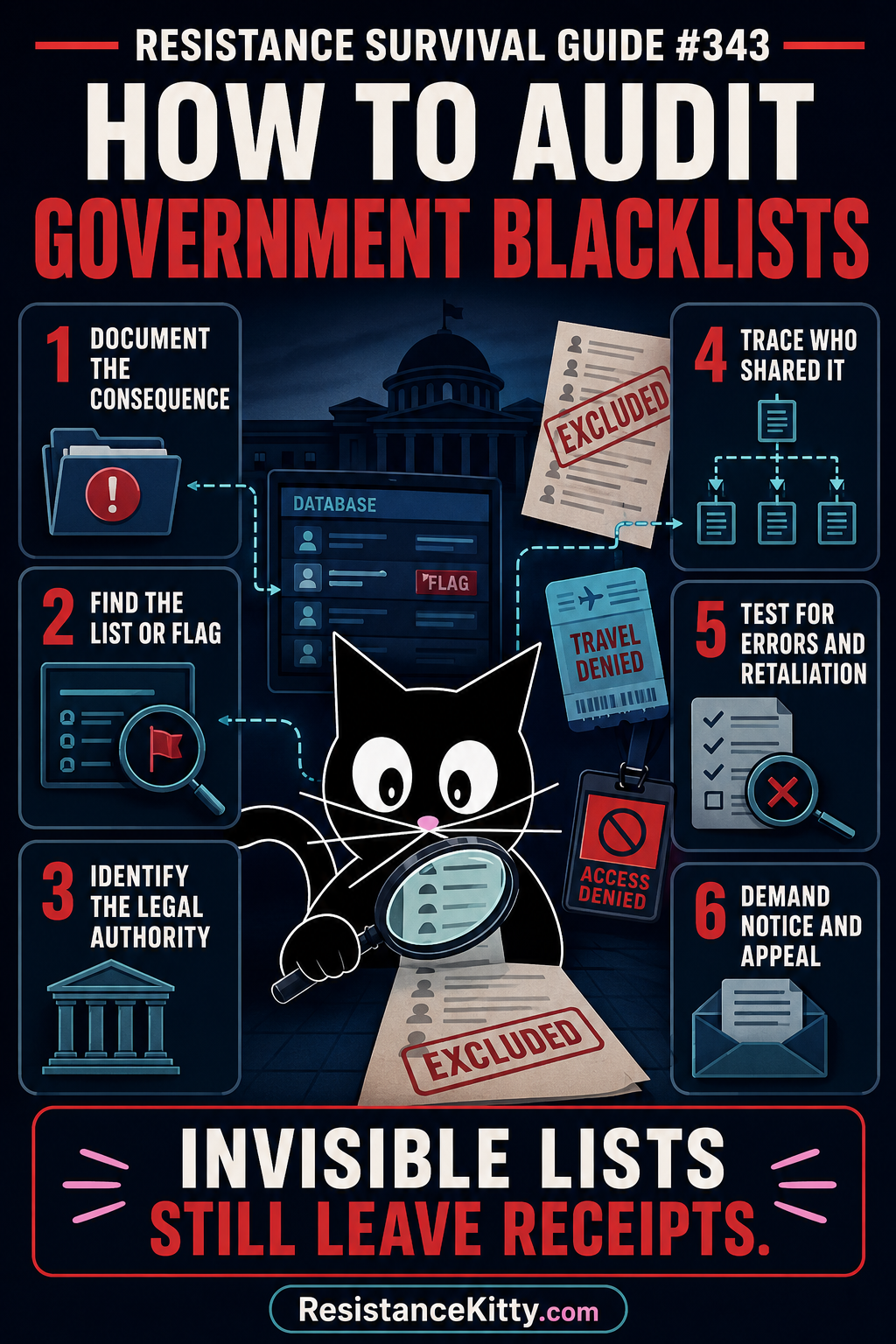
Government agencies maintain lists for legitimate administrative reasons. Some identify suspended contractors. Others flag safety concerns, regulate access to secure facilities, screen travelers, restrict licenses, or prevent people from participating in government programs.
Then there are the lists nobody wants to call lists.
A person may discover that she has been quietly marked as disruptive, uncooperative, suspicious, high risk, unsuitable, or simply not welcome. She receives no formal notice. No official explains the evidence. Each rejection appears isolated, yet the same invisible label follows her from office to office like a bureaucratic ghost with excellent dental coverage.
This Resistance Survival Guide explains how to audit government blacklists, watchlists, exclusion databases, do not admit records, vendor restrictions, informal access bans, and other systems that limit a person or organization without a transparent decision. The objective is to identify the record, authority, decision maker, consequences, evidence, sharing network, and available path for correction.
What Counts as a Government Blacklist
A blacklist is not a single legal category. It can be a formal government database created by law, a local spreadsheet maintained by staff, a warning entered into a case management system, or an informal instruction circulated by email.
Formal systems include terrorist watchlists, contractor exclusions, professional disciplinary lists, sanctions records, facility access restrictions, and program disqualifications. These systems usually have written authority, eligibility criteria, and some form of review.
Informal exclusion systems are harder to identify. They may appear as internal notes, unfavorable flags, risk labels, referral codes, restricted visitor records, unofficial vendor lists, shared intelligence bulletins, or instructions to deny access without explaining why.
Do not combine every system into one conspiracy. A federal contracting debarment is not the same as placement on a travel watchlist. The useful question is whether the government imposed a consequence based on recorded information and whether the affected person had a fair opportunity to understand and challenge it.
Why Informal Exclusion Is So Powerful
Formal government action usually creates paperwork. An applicant receives a denial, a contractor receives notice, or a license holder receives an administrative order.
Informal exclusion can avoid that inconvenience. Officials may delay an application, refuse meetings, increase screening, discourage future bids, deny credentials, or repeatedly claim that another office made the decision.
The absence of a formal denial makes the system difficult to appeal. It can also conceal discrimination, retaliation, mistaken identity, outdated information, or unverified allegations. Nothing says procedural fairness quite like being punished by a record the agency refuses to admit exists.
The Legal Framework Depends on the List
Federal contractor suspension and debarment are governed by formal rules. The Federal Acquisition Regulation establishes procedures for suspension, debarment, notice, evidence, decisions, and government wide exclusion. Active federal exclusion records can be searched through the System for Award Management.
Travel watchlists operate under a different structure. People experiencing repeated travel screening or denied boarding may use the Department of Homeland Security Traveler Redress Inquiry Program. A 2025 Government Accountability Office review explains the federal watchlist nomination and redress processes.
The Privacy Act may allow a person to request access to or amendment of certain federal records about herself. However, exemptions can restrict those rights, particularly for law enforcement and national security systems. State public records laws, administrative procedure statutes, constitutional protections, civil rights laws, and agency specific appeal rules may also apply.
The correct remedy depends on the exact system. First identify the machinery. Then begin kicking its tires.
Step by Step Guide
Step One: Document the Consequence
Begin with what actually happened. Record every denial, delay, additional screening, removal, access restriction, rejected bid, suspended account, credential problem, or unexplained change in treatment.
Save letters, emails, portal messages, screenshots, receipts, boarding documents, application records, meeting notices, and names of officials. Record the date, location, agency, office, and explanation given.
A pattern requires comparable events. “Something feels wrong” is a starting point. “Four offices used the same unusual phrase within six weeks” is evidence worth examining.
Step Two: Identify the Government Decision
Determine what benefit, opportunity, access, or status was affected. Ask whether the government denied entry, employment, funding, travel, a contract, a permit, a license, a meeting, or participation in a public program.
Request the exact name of the decision, the office responsible, the governing policy, and the appeal procedure. Officials sometimes describe a mandatory exclusion as staff discretion or a final decision as an administrative delay.
Make them define the action before they disappear into the traditional government habitat known as “not my department.”
Step Three: Search for the Official List
Search the agency website, regulations, policy manuals, privacy notices, inspector general reports, meeting records, procurement systems, and public database descriptions.
Use terms such as exclusion, ineligible, restricted, suspended, barred, flagged, high risk, unsuitable, denied access, security concern, adverse information, referral, caution indicator, and special handling.
For federal contracts and assistance, search SAM exclusions by the full name, aliases, business names, and identifying information. A similar name is not proof of a match. SAM itself warns users to examine the complete record and contact the agency that created the exclusion.
Step Four: Look for the Unofficial List
Search public records for spreadsheets, shared drives, distribution lists, internal trackers, case notes, email groups, bulletins, access control databases, and staff instructions.
Ask for records containing phrases used during the denial. If an official said the person was “not approved for engagement,” request policies, guidance, emails, and database fields containing that exact phrase.
Informal systems often reveal themselves through repeated language. Bureaucrats may conceal the list while faithfully copying its wording into every rejection.
Step Five: Map Every Agency and Contractor Involved
Identify the office that entered the information, the system owner, the official who approved the action, and every agency or contractor that received the record.
Request data sharing agreements, memoranda of understanding, contractor statements of work, database diagrams, user guides, access lists, privacy assessments, and dissemination policies.
A local flag can become a national problem when another system imports it. Find both the original source and every downstream recipient.
Step Six: Establish the Legal Authority
Locate the statute, regulation, ordinance, executive order, contract clause, policy, or administrative rule authorizing the exclusion.
Record the required criteria, evidence standard, decision maker, notice requirements, duration, review schedule, and appeal rights. Determine whether the agency followed each requirement.
If officials cannot identify the authority, document that failure. Government power should not be operating under the legal doctrine of “a woman in the office told us to.”
Step Seven: Request the Criteria and Codes
Ask for the definitions of every category, code, flag, score, status, and handling instruction connected to the system.
Request the criteria for placement, escalation, renewal, dissemination, removal, and correction. Ask whether a human reviews automated recommendations and whether the agency audits false matches.
A label such as high risk is not self explanatory. It may refer to verified conduct, association, an algorithmic score, an anonymous complaint, or someone selecting the wrong option from a menu.
Step Eight: Obtain the Nomination or Referral Record
Request the record that caused the person or organization to be listed. This may be a nomination form, incident report, investigator referral, staff memorandum, complaint, email, automated alert, or intelligence report.
Ask for the supporting evidence, attachments, source reliability assessment, approval chain, date entered, expiration date, and subsequent reviews.
If the government withholds identifying details, request all reasonably segregable material. Even a heavily redacted form may reveal dates, offices, categories, reviewers, and procedural failures.
Step Nine: Use FOIA and Privacy Act Requests Strategically
For federal systems, use the Freedom of Information Act to request policies, aggregate data, contracts, audits, communications, and records describing how the system operates.
A United States citizen or lawful permanent resident may also use the Privacy Act to request certain federal records about herself. The Justice Department Privacy Act guidance explains that the law provides methods for seeking access to and amendment of records, subject to applicable exemptions.
File separate focused requests when necessary. One request can seek personal records. Another can seek the system rules. Asking for every secret list in America may produce a very efficient rejection.
Step Ten: Test for Mistaken Identity
Compare the listed person’s full name, date of birth, address, business identifiers, aliases, identification numbers, and other distinguishing information with the government record.
Document spelling variations, outdated addresses, merged profiles, duplicate records, and identifiers belonging to another person or company.
For travel problems, DHS states that its redress process can address difficulties caused by names that resemble identities on a watchlist. Mistaken identity is less cinematic than political retaliation, but it can be just as destructive.
Step Eleven: Test for Retaliation and Discrimination
Create a timeline comparing the exclusion with protected speech, complaints, whistleblower activity, journalism, protests, litigation, union organizing, political advocacy, or reports of government misconduct.
Then build a comparison group. Examine whether similarly situated people without the protected characteristic or activity received different treatment.
Timing and unequal treatment can support an inference. They do not prove motive by themselves. Label confirmed facts, documented comparisons, and conclusions separately.
Step Twelve: Measure the Consequences
Calculate the practical effect of the listing. Record lost contracts, denied travel, missed employment, additional screening, legal costs, reputational harm, delayed licenses, lost income, and restricted public access.
Determine whether the exclusion spread to other agencies or private databases. Record each consequence with a date and supporting document.
Government officials may call a flag informational while everyone receiving it treats the person like she arrived carrying a live raccoon and several subpoenas.
Step Thirteen: Audit Notice and Appeal Rights
Determine whether the affected person received notice, the reasons for the decision, an opportunity to respond, access to the evidence, a neutral reviewer, and a written outcome.
In litigation involving the No Fly List, a federal court found that the former redress procedures failed to provide adequate due process. The American Civil Liberties Union summary explains that the court required a more meaningful process.
Do not assume the same ruling controls every exclusion system. Use it as an example of why notice and a genuine opportunity to challenge government action matter.
Step Fourteen: Track Removal Through Every System
If an agency corrects or removes a record, ask whether the change reached every connected database, contractor, partner agency, and archived copy.
Request confirmation of the correction date, systems updated, recipients notified, and future safeguards. Continue documenting adverse consequences after the supposed removal.
A correction that remains trapped in one office while the original accusation continues touring the government is not a correction. It is decorative paperwork.
Step Fifteen: Publish the Findings Responsibly
Create a table showing the system, agency, authority, listing criteria, source record, decision maker, date added, consequences, recipients, review history, and correction status.
Protect personal information, confidential sources, security details, and records involving uninvolved people. Give the agency a meaningful opportunity to respond.
Present evidence without exaggeration. State whether you confirmed a formal listing, found evidence of an informal flag, documented repeated exclusion, or identified unanswered questions.
Red Flags That Deserve Closer Examination
Warning signs include secret criteria, indefinite listings, anonymous allegations treated as fact, missing expiration dates, automated matches without human review, and agencies that refuse to identify the decision maker.
Other concerns include punishment without notice, denial letters containing no appeal instructions, records shared beyond their original purpose, corrections that never reach downstream systems, and restrictions imposed shortly after protected political activity.
Pay special attention when officials insist that no blacklist exists while producing emails discussing who should remain on it. Resistance Kitty appreciates irony, but preferably not as a system of government.
What a Strong Blacklist Audit Should Prove
A responsible audit should establish what consequence occurred, which record caused it, who created that record, what authority governed the decision, where the information traveled, and whether a meaningful correction process existed.
It should also distinguish an official exclusion from repeated discretionary decisions. Informal exclusion may be harder to prove, but consistent language, shared records, coordinated conduct, and documented internal instructions can reveal the structure.
When the evidence remains incomplete, describe the gap. Do not fill government silence with certainty.
Turning the Findings Into Accountability
Send documented findings to the agency inspector general, ombudsman, privacy office, civil rights office, legislative oversight committee, independent journalist, or qualified civil liberties attorney.
Ask the agency to publish its criteria, notice procedures, appeal rights, retention periods, error rates, audit findings, and aggregate removal statistics.
Recommend automatic expiration dates, regular review, source verification, meaningful notice, independent appeals, complete correction of downstream records, and penalties for retaliatory listings.
The goal is not to eliminate every legitimate exclusion system. It is to prevent government agencies from quietly imposing serious consequences through invisible records that nobody is responsible for maintaining and nobody is willing to defend.
Closing RK Thoughts
Government blacklists are most dangerous when their effects are obvious but their existence remains deniable. A person loses access, work, travel, or opportunity while every office claims it merely followed information supplied by someone else.
Auditing these systems requires patience. The authority may appear in a regulation. The flag may live inside a database. The explanation may hide in an email. The consequence may emerge through a dozen decisions that look unrelated until someone places them in chronological order.
Build that record.
Resistance Kitty does not object to the government protecting legitimate public interests. She objects when an invisible accusation becomes a permanent sentence administered by dropdown menu.
If the government has created a list, it should be able to explain who goes on it, who stays on it, and how an innocent person gets off it.
Sources
- Department of Homeland Security Traveler Redress Inquiry Program
- Government Accountability Office Review of Watchlist Nomination and Redress
- Federal Acquisition Regulation on Suspension and Debarment
- Federal Acquisition Regulation on the Effect of Exclusion
- System for Award Management Exclusion Search
- SAM Exclusion Types
- Freedom of Information Act Request Guide
- Justice Department Privacy Act Guidance
- Justice Department Privacy Act Agency Requirements
- American Civil Liberties Union Watchlist Resources
- American Civil Liberties Union No Fly List Rights Guide
- Government Accountability Office Guidance on Data Mining Oversight